
South Asia Intelligence Review
Managed Stability
Sri Lanka entered 2026 with a security environment that remained broadly stable but layered with unresolved structural vulnerabilities rooted in post-war reconciliation failures, persistent diaspora activism, narcotics trafficking, and evolving regional security dynamics. While the country continued to record an absence of terrorism-linked fatalities, sustaining its position among the lowest-risk nations globally, the year nonetheless underscored the paradox of “negative peace” – the absence of violence without the resolution of underlying political and ethnic contestations. The National People’s Power (NPP) Government, led by President Anura Kumara Dissanayake and Prime Minister Harini Amarasuriya, inherited a security architecture shaped by long-standing counterterrorism frameworks, and largely opted for continuity rather than rupture, particularly in matters related to proscription regimes and intelligence-led policing.
A defining development shaping the 2026 security narrative was the January 13 decision of the NPP Government to issue an extraordinary gazette extending the long-standing ban on the Liberation Tigers of Tamil Eelam (LTTE) and multiple Tamil diaspora organisations and individuals. By reissuing and updating the May 2025 proscription list, the Government reaffirmed its position that overseas Tamil political and advocacy bodies continued to pose security risks through alleged terrorism-related activities. Organisations such as the Tamil Rehabilitation Organisation (TRO), Tamil Coordinating Committee (TCC), World Tamil Movement (WTM), Transnational Government of Tamil Eelam (TGTE), World Tamil Relief Fund (WTRF), National Council of Canadian Tamils (NCCT), and Tamil Youth Organisation (TYO) remained blacklisted, with updated identification details and new reference numbers issued for 2026. Although no substantive new allegations were introduced, the continuation of this sweeping proscription regime reinforced the securitised lens through which the Sri Lankan State continues to view diaspora mobilisation more than 15 years after the end of the civil war. Originally introduced in 2014 under President Mahinda Rajapaksa, the proscription framework continues to criminalise contact with listed entities, constraining political engagement and perpetuating mistrust between the State and Tamil communities abroad.
The persistence of such measures stood in sharp contrast to the Government’s stated commitment to reform and accountability and was further complicated by international scrutiny on unresolved war-time accountability. In June 2025, United Nations High Commissioner for Human Rights (UNHCR) Volker Türk’s visit to Sri Lanka brought renewed global attention to the issue of enforced disappearances and accountability for alleged war crimes. Türk met families of the missing in Trincomalee and Jaffna District and received a joint letter from major Tamil political parties, including the Ilankai Tamil Arasu Kachchi, All Ceylon Tamil Congress, and Tamil National People’s Front, warning against the instrumentalisation of international engagement to legitimise State inaction. The absence of tangible progress on accountability, even 16 years after the civil war, continued to fuel Tamil grievances, reinforcing diaspora activism that Colombo simultaneously seeks to suppress through legal mechanisms.
Despite these political fault lines, Sri Lanka’s internal security indicators remained strong. The country continued to benefit from the dismantling of organised terrorist infrastructure following the defeat of the LTTE in 2009 and the sustained weakening of Islamist extremist networks after the 2019 Easter Sunday attacks. Sri Lanka’s zero score in the 2025 Global Terrorism Index and its ranking at 100 out of 163 countries reflected this reality. However, the State remained vigilant against residual extremist threats, particularly transnational Islamic State (IS)-linked networks, as demonstrated by arrests and surveillance operations carried out in preceding years. Intelligence-sharing with regional partners, especially India, remained a key pillar of Sri Lanka’s counterterrorism posture, as illustrated by heightened security checks at Bandaranaike International Airport in May 2025 following intelligence inputs related to a terrorist attack in India.
This overall stability was further corroborated by SATP data, which recorded zero insurgency-related fatalities, insurgent arrests, or surrenders throughout 2025. The absence of any measurable insurgent activity underscored the consolidation of Sri Lanka’s post-war security environment and reinforced official assessments that no organised militant formations were operational within the country during the year.
Another critical dimension shaping the 2026 security outlook was Sri Lanka’s escalating battle against narcotics trafficking, which has increasingly intersected with organised crime and maritime security challenges. On January 18, 2026, Police Media Spokesman Assistant Superintendent of Police F. U. Wootler disclosed that Sri Lanka Police seized over 1,821 kilograms of heroin during island-wide anti-narcotics operations in 2025. Additional seizures included more than 17,189 kilograms of cannabis, 3,865 kilograms of crystal methamphetamine (ICE), and nearly four million narcotic pills. These figures highlighted Sri Lanka’s growing role as both a transit and destination hub within Indian Ocean narcotics networks, driven by its strategic location along major maritime routes. The Government’s decision to continue daily drug raids throughout 2026 under the direct supervision of the Inspector General of Police reflected recognition of narcotics as a serious national security threat, with implications for public health, crime, and institutional corruption.
Efforts to strengthen the credibility of enforcement mechanisms were further reflected in the judicially supervised destruction of seized narcotics. In 2024, nearly 1.9 metric tonnes of heroin, ICE, ketamine, and cocaine were incinerated at facilities in Wanathawilluwa and Puttalam, while an additional 665 kilograms of heroin were destroyed between 2025 and early 2026. These measures were aimed at addressing longstanding concerns over the re-circulation of seized drugs and enhancing public trust in law enforcement agencies. Nevertheless, the scale of seizures underscored the resilience and adaptability of trafficking networks operating across maritime and coastal regions, often exploiting economic vulnerabilities among fishing communities.
Politically, 2026 marked the consolidation phase of the NPP administration, which came to power in 2024 on a platform of anti-corruption, social justice, and systemic reform. While the leadership projected a reformist image, particularly in economic governance, its approach to national security and ethnic reconciliation revealed a cautious pragmatism. The continuation of LTTE-related proscriptions, asset freezes, and surveillance frameworks indicated an unwillingness to dismantle entrenched security doctrines, even as the Government sought to distinguish itself from previous regimes. This balancing act reflected the enduring influence of the security establishment and the political risks associated with appearing “soft” on issues tied to separatism and terrorism.
Regionally, Sri Lanka’s security calculations continued to be influenced by instability in the wider South Asian and Middle Eastern theatres. The 2024 Arugam Bay threat against Israeli tourists, linked to tensions arising from the Gaza conflict, remained a reminder of Sri Lanka’s exposure to global geopolitical currents. Although no comparable incident occurred in 2025, the episode reinforced the need for robust intelligence coordination and protection of the tourism sector, a critical pillar of economic recovery.
Internationally, Sri Lanka maintained engagement with multilateral counterterrorism frameworks, building on earlier participation in initiatives such as the Combined Maritime Forces and its chairmanship of the Indian Ocean Rim Association. The European Union’s extension of its LTTE ban in July 2024 continued into the assessment period, providing Colombo with diplomatic validation of its counterterrorism stance. At the same time, Western governments and UN mechanisms sustained pressure on Sri Lanka to address accountability deficits, creating a dual-track international environment of cooperation and criticism.
In sum, Sri Lanka’s security environment in 2026 was characterised by stability without closure. The absence of terrorist violence masked deeper unresolved tensions rooted in ethnic reconciliation, diaspora-State relations, and transitional justice. While the NPP Government succeeded in maintaining law and order and strengthening narcotics enforcement, it stopped short of initiating transformative reforms in the security sector or accountability mechanisms. The persistence of expansive proscription regimes and securitised governance approaches risks entrenching long-term grievances, even as immediate threats remain contained. Sri Lanka’s challenge moving forward lies in transitioning from a security paradigm focused on control and continuity to one that addresses the political and social foundations of lasting peace, without undermining the hard-won gains of post-war stability.
Jharkhand: Strategic successes
On January 23, 2026, two Communist Party of India-Maoist (CPI-Maoist) cadres were killed during an ongoing anti-Maoist operation in the Saranda Forest area near Kumbhdih village, under the Chotanagra Police Station limits in the West Singhbhum District of Jharkhand. A senior Police official disclosed that the action on the 23rd was a continuation of the offensive of January 22, as Security Forces (SFs) pressed ahead with a large-scale operation against insurgents in the region. Operation Meghaburu, launched on the 22nd by 209 CoBRA (Commando battalion for resolute Action), the Chaibasa District Police, and Jharkhand Jaguar in the Saranda Forest, aimed to dismantle Maoist strongholds in the mineral-rich Saranda area, which has long been considered a key base of Left-Wing Extremism (LWE). Arms, ammunition, and other incriminating materials were reportedly recovered from the encounter site.
On January 22, 2026, at least 15 CPI-Maoist cadres, including senior leader Patiram Manjhi aka Patiram Marandi aka Anal Da aka Tufan aka Ramesh, a Central Committee Member (CCM) who served as the ‘Secretary’ of the Bihar-Jharkhand Special Area Committee (BJSAC) and carried a bounty of INR 10 million, were killed in a fierce encounter with SFs in the Saranda Forest area near Kumbhdih village, under the Chotanagra Police Station limits in West Singhbhum District. The encounter broke out after SFs launched a joint operation based on specific intelligence regarding Maoist movement in the area. The Maoists, who were reportedly lying in ambush, opened indiscriminate fire on the security personnel. The forces retaliated and strategically surrounded the Maoists and, after several hours of intense exchange of fire, neutralised them. During the subsequent search operation, 15 bodies were recovered along with a large quantity of weapons and daily-use items. Apart from Patiram Manjhi, who was considered one of the rebels’ key strategists, others identified were Lalchand Hembram aka Anmol, Amit Munda, Rapa Munda aka Powell, Samir Soren aka Samay Soren, Pintu Lohra, Laljit, and Rajesh Munda. The eight female Maoist cadres killed were identified as Babita and Purnima Gope [area committee members (ACMs)], Somwari Purty, a Local Guerrilla Squad Member (LGSM), Surajmuni, carried a bounty of INR 100,000, as well as Jonga, Soma Honhaga, Mukti Honhaga, and Sarita.
These incidents reflect sustained counter-insurgency pressure by SFs, resulting in measurable attrition of LWE cadre strength and leadership, significant seizures of arms and explosives, and the targeted arrest or neutralisation of key leaders, even as insurgent groups demonstrated limited tactical adaptation. These trends will shape the operational and strategic environment in 2026.
At least 17 Naxalites (Left Wing Extremists, LWEs) have been killed in the State since the beginning of the current year, thus far (data till February 1, 2026). According to partial data collated by the South Asia Terrorism Portal (SATP), 41 Naxalites were killed in Jharkhand in 2025, in addition to 11 in 2024 and 14 in 2023. The total number of Naxalites killed in the state since March 6, 2000, when SATP began documenting LWE-related violence, stands at 851.
Meanwhile, at least 70 Naxalites were arrested in 2025, in addition to 79 such arrests in 2024. 114 Naxalites were arrested in 2023 and 195 in 2022. Until January 30, 2026, one Naxalite had been arrested in the current year. Mounting SF pressure also yielded the surrender of 21 Naxalites in 2025, in addition to 26 such surrenders in 2024, 33 in 2023, and 18 in 2022. No Naxalites have surrendered in the current year as yet (data till February 1, 2026).
In the fight against the extremists, fatalities in the SF category registered a spike. Seven SF personnel were killed in 2025 as against three in 2024. A low of two SF fatalities was recorded twice, in 2020 and 2022. Fatalities in this category crossed 70 in two years, 77 in 2002 and 71 in 2009. A total of 556 SF killings have been recorded in Jharkhand since March 6, 2000.
The SF:Maoist kill ratio remained in favour of the SFs, at 1:5.85 in 2025, up from 1:3.66 in 2024. The overall kill ratio since March 6, 2000, favoured the SFs at 1:1.53. The most favourable ratio was recorded in 2020, at 1:9.
Seven civilians were killed through 2025 in Jharkhand as compared to 12 such killings in 2024. The 2025 fatalities were the second lowest in this category since March 6, 2000. A low of six civilian fatalities was recorded in 2022, while a high of 79 civilian fatalities was recorded in 2011. A total of 823 such killings have been recorded since March 6, 2000.
The number of Districts from where killings were reported increased in 2025. Out of a total of 24 Districts in Jharkhand, fatalities were reported from seven in 2025 – West Singhbhum (23); Bokaro (13); Latehar (five); Gumla and Palamu (four each); Hazaribagh and Chatra (three each). Five Districts recorded such fatalities in 2024 – West Singhbhum (17); Chatra (six); and Hazaribagh, Latehar, and Lohardaga (one each).
Meanwhile, an analysis of overground and underground LWE activities in the State in 2025 indicates two districts – West Singhbhum and Bokaro – remained ‘moderately affected’, and six districts – Latehar, Gumla, Palamu, Hazaribagh, Chatra, and Ranchi – were ‘marginally affected’. By comparison, in 2024, one district – West Singhbhum – was ‘moderately affected’, while 12 districts – Chatra, Hazaribagh, Latehar, Lohardaga, Bokaro, Garhwa, Giridih, Gumla, Khunti, Palamu, Ramgarh, and Ranchi – were ‘marginally affected.’
While Maoist influence spanned multiple districts in Jharkhand, by late 2025 the intensity of insurgent incidents had become markedly concentrated in areas such as West Singhbhum, with residual activity confined to pockets of Latehar, Gumla, and Simdega. Official data and media reports consistently identified West Singhbhum as the most affected district, while other districts registered moderate to low levels of Maoist activity. The overall number of LWE-affected districts has declined significantly in recent years, reflecting a steadily narrowing operational footprint of the Maoists.
Amid sustained counter-insurgency operations, Maoist tactics in Jharkhand reflected both desperation and adaptability. Despite mounting pressure, insurgents continued to deploy Improvised Explosive Devices (IEDs) as both deterrent and offensive tools. Periodic discoveries and defusing of such devices underscored these efforts. According to SATP data, SFs foiled Maoist designs and recovered arms and ammunition on 58 occasions in 2025, compared to 41 such recoveries in 2024, reflecting continued attempts by cadres to target SFs and disrupt operations, even as their overall operational capacity diminished.
Despite significant gains, security operations entailed notable risk and sacrifice. On October 10, 2025, a Central Reserve Police Force (CRPF) constable, Head Constable Mahendra Laskar, succumbed to injuries sustained in an IED blast during an anti-Naxal engagement in West Singhbhum. The incident underscored the persistent dangers posed by residual insurgent elements and the inherent complexity of demining operations.
The National Investigation Agency (NIA) has taken several steps against LWE elements in the state. Most recently, on September 26, 2025, NIA chargesheeted a key accused in a 2024 case relating to an attack by CPI-Maoist cadres on SFs in Jharkhand. The accused, Abhijeet Koda aka Sunil Koda aka Matla Koda aka Matlu, a resident of Jamui District in Bihar, was booked under multiple provisions of the Indian Penal Code (IPC), the Arms Act, the Explosive Substances Act, the Criminal Law Amendment (CLA) Act of 1908, and the Unlawful Activities Prevention Act (UAPA) of 1967. The chargesheet was filed before the NIA Special Court in Ranchi, Jharkhand. According to the NIA, Koda, an armed cadre of the CPI-Maoist, was part of the banned outfit’s larger conspiracy to carry out terrorist acts and strengthen its network in coordination with other leaders and members.
On the same day, NIA filed a second supplementary charge sheet against two individuals in connection with a CPI-Maoist terrorism conspiracy case involving the seizure of explosives and other incriminating materials in Jharkhand. The accused, Jaipal Deogam from the West Singhbhum District of Jharkhand and Budru Padam aka Rohit Padam from the Bijapur District of Chhattisgarh, were charged under various sections of the IPC and UAPA. The charge sheet was submitted before the NIA Special Court in Ranchi. According to the NIA, the investigation uncovered a cache of items buried in the forest area between villages Husipi and Rajabhasa in West Singhbhum. The seized materials included INR 1.05 million in cash, walkie-talkie sets, a Samsung tablet, a power bank, a radio set, ‘levy’ (extortion money) collection receipts, gelatine sticks, and other equipment believed to be used in Maoist operations.
Meanwhile, security agencies have also focused on achieving territorial dominance by establishing Forward Operating Bases (FOBs) in deep forest areas such as Tonto, Kuira, and adjoining pockets, sharply restricting Maoist movement and supply routes. With the security situation improving, the district administration has accelerated developmental activities in previously inaccessible areas. Road construction, mobile tower installations, and government outreach initiatives such as ‘Aapki Yojana, Aapki Sarkar, Aapke Dwar’ (Your Scheme, Your Government, at Your Doorstep) have begun reaching remote villages that were long cut off due to IED threats.
In 2025, though the State experienced a waning influence of LWE factions including the People’s Liberation Front of India (PLFI), the Tritiya Prastuti Committee (TPC), Jharkhand Jan Mukti Parishad (JJMP) and other lesser CPI-Maoist splinters, residual threats persist. At least 10 incidents were attributed to the PLFI, including two resulting in the deaths of three cadres, seven of arrest resulting in the arrest of 17 cadres, and one of issuing a threat/warning. The Tritiya Sammelan Prastuti Committee (TSPC)/TPC was involved in 18 incidents – three of killing, resulting in the killing of two SF personnel, two civilians, and one TSPC/TPC cadre; nine incidents of arrest resulting in the arrest of 12 cadres; one incident of surrender resulting in the surrender of two TSPC cadres; one incident of arson; exchanged fire with SFs on three occasions; and one incident of threat/warning. JJMP was involved in 12 incidents – three of killing, resulting in the killing of eight cadres; five of arrest, resulting in the arrest of seven cadres; three of surrender, resulting in the surrender of 14 cadres; and one incident of vandalism.
The most recent incident linked to Maoist splinter groups was recorded on September 4, 2025, when two SF personnel were killed and another injured in an exchange of fire during an operation against TSPC/TPC in the Kedal area of Palamu District. The operation was launched on the basis of specific intelligence regarding the presence of TSPC ‘commander’ Shashikant Ganjhu. In another incident attributed to the outfit, on August 23, 2025, at least six coal-mining vehicles were set ablaze, allegedly by TSPC/TPC cadres, at the Tapin North coal mining project of the Central Coalfields Limited (CCL) under Charhi Police Station limits in Hazaribagh District. A leaflet issued by the TSPC/TPC was recovered from near the site.
A report dated January 28, 2026, indicates that only 50-60 active Maoist cadres are estimated to remain in the State, as SFs intensify operations ahead of the Union Government’s stated deadline to eradicate Left-Wing Extremism from the country by March this year.
Amid the ongoing campaign against the Naxalites in the State, deficits in the Police force endure. According to the latest data provided by the Bureau of Police Research and Development (BPR&D), the State had a police-population ratio (policemen per hundred thousand population), as of January 1, 2024, of 151.80, significantly lower than the sanctioned strength of 208.51. The ratio is also marginally lower than the national average of 154.96, which itself is significantly lower than its sanctioned strength of 197.44. The ratio declined from 157.71 per 100,000 on January 1, 2023, when the national average was 154.84. Similarly, the number of Police personnel per 100 square kilometres of area was 75.71, significantly lower than the sanctioned strength of 103.99, though higher than the national average of 65.78. The ratio has declined marginally from 77.67 on January 1, 2023, when the national average was 65.14. According to BPR&D data, there was a vacancy of 22,544 personnel (27.19 per cent of the sanctioned strength of 82,894) in the State. Furthermore, of a sanctioned strength of 158 apex Indian Police Service (IPS) officers in the State, 11 posts (6.96 per cent) remained vacant.
By the end of 2025 and into early 2026, senior Police and government officials conveyed a strong strategic commitment to eliminating Maoist influence in Jharkhand. Both the Union Home Ministry and State authorities reaffirmed objectives aligned with the targeted eradication of the Maoist insurgency by March 2026, reinforcing a sense of final-phase operations across residual pockets. Statements by Jharkhand’s Director General of Police (DGP) in early 2026 emphasised the continuation of operations in regions such as the Saranda Forest until all insurgent elements are flushed out, indicating a sustained offensive rather than any diminution of effort. On January 24, 2026, Jharkhand Director General of Police (DGP) Tadasha Mishra warned the remaining ultras, “Shun arms and join mainstream to reap the benefits of the rehabilitation scheme of the state government or each one of you will be eliminated.”
2025 marked a decisive phase in Jharkhand’s long counter-Maoist campaign. Violence levels reached historic lows, leadership structures were systematically dismantled, and the insurgency was confined to shrinking geographical pockets. The combined effect of kinetic operations, intelligence-led policing, NIA interventions, and the developmental outreach substantially altered the operational environment to the disadvantage of the Maoists. Strategic successes in 2025 provide a foundation for a final phase of operations envisaged for 2026, but sustained progress will hinge on integrating security, development, and governance strategies that address persistent deficits, as much as insurgent symptoms. As Jharkhand moves through 2026, the Maoist insurgency in the State appears strategically defeated but tactically residual. The challenge ahead lies not merely in eliminating the last armed squads, but in preventing ideological revival, ensuring institutional governance, and consolidating peace through sustained development and rule of law. If present trends continue, Jharkhand is well-positioned to transition from a former LWE epicentre to a post-insurgency stabilization phase, contributing decisively to the national objective of ending Left-Wing Extremism in India.
Weekly Fatalities: Major Conflicts in South Asia
January 26- February 1, 2026
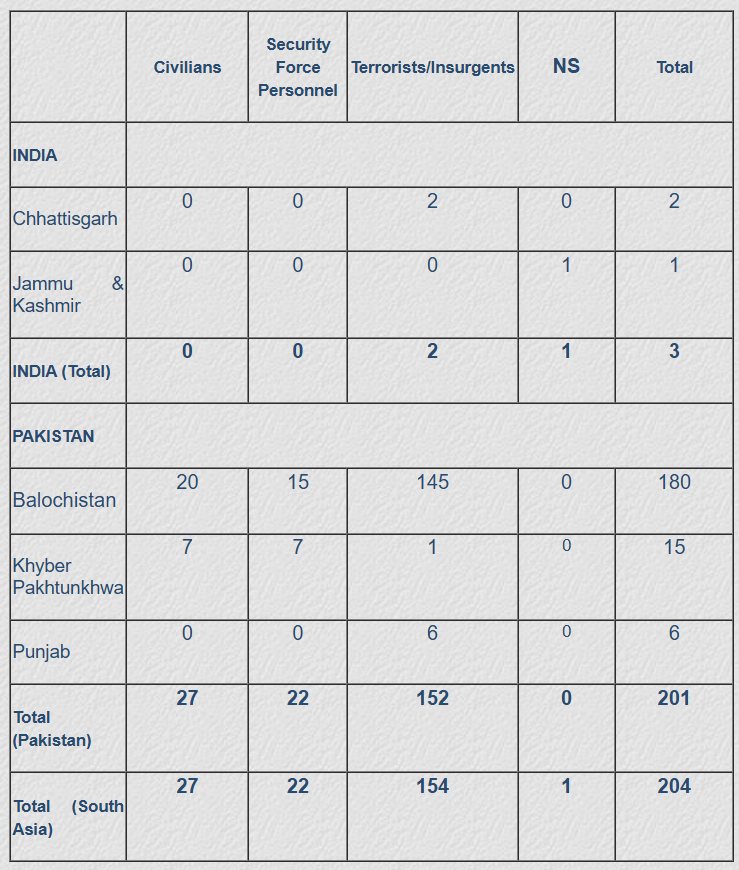
Provisional data compiled from English language media sources.