
SOUTH ASIA INTELLIGENCE REVIEW
Khyber Pakhtunkhwa: Persistent Peril
On March 7, 2026, three Policemen were killed while 31 people, including five Policemen and 26 civilians, were injured in an improvised explosive device (IED) blast in the Rustam Bazaar area of Wana tehsil (revenue unit) in the South Waziristan District of Khyber Pakhtunkhwa (KP). According to the Police, the explosion occurred when Policemen on routine patrol were present in the area, around 5 pm. Wana Circle Deputy Superintendent of Police (DSP) Asghar Ali Shah said that the explosive material had been planted at the main entrance of the supermarket and was detonated through a remote control or timed device.
On March 7, two people were killed while seven sustained injuries when a quadcopter drone attacked relatives of the Police peace committee in the Manjiwala area of Lakki Marwat District.
On March 6, one person was killed while 19, including two Security Forces (SFs) personnel, were injured in a suicide attack near the Chashma Pul Check Post on the Bannu-Miranshah main road in the Miranshah tehsil of North Waziristan District. Police disclosed that the blast was caused by the detonation of explosives in a vehicle near the checkpost. The Hafiz Gul Bahadur (HGB)-linked Aswad-ul-Khurasan claimed responsibility for the suicide attack, adding that the bomber was from the Al-Hamid suicide force.
On March 4, two Government officials were killed when a bomb landed in the Miranshah camp, the administrative headquarters of North Waziristan District.
On March 4, four terrorists including a key ‘commander’ were killed when a deadly clash erupted between Tehreek-e-Taliban Pakistan (TTP) and Islamic State Khorasan Province (ISKP) in the mountainous area of Ghaljo Narai in Orakzai District. According to local Police, during the exchange of fire, ISKP’s key ‘commander’, Haji Rehman aka Haji Dada, was killed along with three of his associates.
According to partial data compiled by the South Asia Terrorism Portal (SATP), 276 terrorism-related fatalities, including 48 civilians, 71 SF personnel and 157 terrorists, have been reported in the current year, thus far, in KP (data till March 7, 2026). During the corresponding period of 2025, the province recorded 442 fatalities (47 civilians, 83 SF personnel and 312 terrorists).
KP recorded a total of 2,359 fatalities (268 civilians, 455 SF personnel and 1,636 terrorists) in 545 incidents of killing in 2025, as against 1,363 such fatalities (288 civilians, 421 SF personnel, and 654 terrorists) in 487 such incidents in 2024, registering an increase of 73.07 per cent in overall fatalities. On year-on-year basis, overall fatalities have been on a continuous rise since 2020, with an increase from 130 (30 civilians, 69 SF personnel, and 31 terrorists) in 2019 to 216 (61 civilians, 57 SF personnel, and 98 terrorists) in 2020, 301 (72 civilians, 108 SF personnel, and 121 terrorists) in 2021, 527 (119 civilians, 173 SF personnel, and 235 terrorists) in 2022 and further, 941 (205 civilians, 329 SF personnel, and 407 terrorists) in 2023.
Significantly, overall fatalities declined between 2014 and 2019, barring 2018, when they increased to 167, from 129 in 2017. Fatalities had fallen from 946 in 2013 to 607 in 2014, 298 in 2015, and 215 in 2016. Overall fatalities in 2025, at 2,359, broke record of highest fatalities in terrorism-related incidents over the preceding 15 years, since 2009, when 5,883 fatalities were recorded in the province.
Other parameters of violence also underlined the deteriorating security situation in the province in 2025. Fatal terrorism-linked incidents jumped from 702 in 2024 to 766 in 2025, the highest since 2009, when there were 1,432 such incidents. The number of major incidents (each involving three or more fatalities) increased from 140 in 2024 to 245 in 2024, the highest since 2009, when there were 341 such incidents; the resultant fatalities in such attacks also increased from 891 in 2024 to 1,913 in 2025. Similarly, KP accounted for an increased number of explosions, from 142 in 2024 to 159 in 2025 (the highest since 2013, when there were 198 such incidents), with the resulting fatalities in such attacks spiking from 207 to 327.
Similarly, the province recorded an increased number of suicide attacks, from 15 in 2024 to 18 in 2025, with resultant fatalities rising from 93 in 2024 to 151 in 2025. In the worst attack, on June 28, 2025, 13 SF personnel were killed when a suicide bomber rammed an explosive laden vehicle into a Mine-Resistant Ambush Protected (MRAP) vehicle belonging to the Bomb Disposal Unit (BDU) in the Khadi Khel area of Mir Ali tehsil in North Waziristan District. At least 24 persons, with 14 civilians – including women and children – sustained injuries. Following the attack, SFs launched a sanitisation operation in the area, killed at least 14 terrorists. The Hafiz Gul Bahadar affiliated Aswad-ul-Harb’s sub-faction, the Huzaifa suicide bombing cell, claimed responsibility for the attack. The Ittehadul Mujahideen Pakistan (IMP) umbrella alliance linked to Hafiz Gul Bahadur and Lashkar-e-Islam (LI) also claimed for the attack.
Despite a year of rampant violence, the territorial footprint of terrorist groups actually diminished across the Province’s districts. Of 40 districts in KP, 24 recorded terrorism-related violence in 2025, as against 28 Districts in 2024, according to the SATP database. Of 40 districts, 22 districts registered terrorism-related incidents in 2023; 16 in 2022; 21 in 2021; and19 districts in 2020.
The most violent district in 2025 was North Waziristan, with 498 fatalities, followed by Dera Ismail Khan (245 fatalities), Bannu (234 fatalities) and South Waziristan (225 fatalities). In 2024 as well, North Waziristan was the most violent district, with 271 fatalities, followed by South Waziristan (163 fatalities), Khyber (137 fatalities) and Kurram (126 fatalities). In 2023, again, North Waziristan was the most violent District, with 151 fatalities, followed by Peshawar (122), Dera Ismail Khan (109) and South Waziristan (107). In 2022, again, North Waziristan District accounted for 177 fatalities, followed by Peshawar (87), Bannu (60) and Dera Ismail Khan (43). In 2021 again, Waziristan recorded the maximum of 106 fatalities, followed by South Waziristan (51), Peshawar (25) and Bajaur (22). In 2020, North Waziristan recorded 110 fatalities, followed by Peshawar (27) and South Waziristan (21).
In 2025, sectarian violence in KP did not increase, while the province had experienced significant escalation in such violence in 2024, particularly due to the sectarian conflict between Sunni and Shia Muslim groups in Kurram District. Though sectarian conflict between Sunni and Shia Muslim groups is not a new phenomenon in Kurram District, the renewed skirmishing in the district, commencing November 21, 2024, took over a hundred lives. Despite curfews and a ceasefire, sporadic violence continued till the end of 2024. The KP Government disclosed, on January 1, 2025, that both warring Shia and Sunni tribes in Kurram Districts finally signed a peace agreement after more than three weeks of efforts to broker a ceasefire.
Despite the peace agreement, the warring groups never entirely ceased their exchanges of fire. On January 16, 2025, 10 persons, including six drivers, two passengers and two soldiers, were killed in an attack on an aid convoy carrying essential goods to the sectarian violence-marred Kurram District, near the Bagan area. Six terrorists were killed in SF retaliation. At least 10 terrorists and four SF personnel also sustained injuries during the clash. Further, on February 17, 2025, nine persons, including five SF personnel, a truck driver, a passer-by and two attackers, were killed, while another 15, including four drivers and one Police officer were injured, when an aid convoy, consisting of 64 vehicles, en-route to Parachinar, were attacked by unidentified terrorists in the Char Khail, Uchit Baghan and Mandori areas. Another major sectarian attack in the District was on September 3, 2025, when unidentified assailants attacked a passenger vehicle near the Ahmad Khan Kalle area of Kurram, killing at least seven people.
The surge over the past years, in terrorism-related violence in the province can be attributed to three principal factors. First, the United States (US)-Western withdrawal from neighbouring Afghanistan. Second, the fall of Kabul to the Taliban on August 14, 2021. And finally, the collapse of ‘official talks’ between the Pakistan Government and the TTP on November 28, 2022. The spike in violence in KP was foreseeable, when TTP chief Mufti Noor Wali, in the wake of the collapse of peace-talks, asked his fighters to resume attacks.
When the US pulled its forces out from Afghanistan in 2021, it left behind around USD 7 billion worth of military equipment and weapons, including firearms, communications gear, and even armoured vehicles. The Afghan Taliban seized these weapons during the chaotic US withdrawal. On October 10, 2025, Pakistan’s ISPR spokesperson, Major General Ahmed Sharif Chaudhry, claimed that weapons left behind by the US after its withdrawal from Afghanistan had fallen into the hands of TTP militants. Speaking at a press conference in Peshawar, Chaudhry asserted that the Pakistan Army had seized a number of American-made weapons during recent operations against militants. He confirmed that military assessments indicated more than USD 7 billion worth of weapons were abandoned in Afghanistan, many of which were being used by TTP. Chaudhry added that more than 3,000 militant attacks had occurred in Khyber Pakhtunkhwa province over the preceding three months.
With the fall of Kabul to the Afghan Taliban on August 14, 2021, TTP found support from their ideological brothers in their campaigns against Pakistan. On February 4, 2026, the 37th report of the Analytical Support and Sanctions Monitoring Team submitted to the United Nation Security Council (UNSC), revealed that the attacks on Pakistan by the TTP from Afghanistan increased. The report noted that Afghanistan had become a sanctuary for militants who used its territory to launch attacks on Pakistan, but also came at a time when the country was facing a renewed spate of violence. The report noted,
There was an increase in attacks in Pakistan launched by TTP (Tehreek-e Taliban Pakistan) in Afghanistan, which led to military exchanges. Regional relations remained fragile. Islamic State in Iraq and the Levant-Khorasan (ISIL-K) was under sustained counter-terrorism pressure, but it retained a potent capability, coupled with intent to conduct external operations.
The collapse of ‘official talks’ between the then PTI-led Pakistan Government and TTP on November 28, 2022, further aggravated the security situation in the province. On December 16, 2024, the then KP Chief Minister Ali Amin Gandapur claimed that between 22,000 and 24,000 TTP members, had found safe haven in Afghanistan. Gandapur also claimed that an additional 16,000 to 18,000 TTP fighters were operating inside Pakistan. He acknowledged that Pakistan lacked the capacity to maintain law and order along its extensive border with Afghanistan.
On December 6, 2025, the KP Counter-Terrorism Department (CTD) released terrorism statistics for the year, showing a rise in attacks on the Police and significant increases in arrests and intelligence operations. According to the CTD, attacks on the Police rose from 327 in 2024, to 510 in 2025. The CTD also reported the arrest of 25 high-value terrorists, whose carried a bounty on their heads. Intelligence operations increased slightly, by 3 per cent, with 2,791 operations conducted in 2025 compared to 2,703 in 2024. Overall arrests surged from 744 in 2024 to 1,244 in 2025, marking a 40.2 per cent increase. Despite the rise in arrests, terrorist attacks decreased only marginally, with 137 attacks recorded in 2025, compared to 147 the previous year. The number of registered terrorism cases rose by 50 per cent, from 1,058 to 1,588. Police also carried out 320 retaliatory operations in response to 158 terrorist attacks.
Further, on December 14, KP Police released a detailed report revealing that 502 persons, including civilians and security personnel, were killed in terrorism incidents during 2025. According to the report, a total of 1,588 terrorist incidents occurred, resulting in the deaths of 223 civilians and injuries to 570. Additionally, 137 Police personnel were killed and 236 were wounded, while 18 law enforcement personnel from other agencies also lost their lives. The report highlighted the toll on the Federal Constabulary, with 124 personnel killed and 244 injured.
Amid a surge in terrorism-related incidents in the province, SFs were increasingly struggling to respond effectively to the evolving tactics and advanced weaponry used by the terrorist groups. On March 27, 2025, KP Inspector General of Police (IGP) Zulfiqar Hameed acknowledged that the provincial Police lacked the modern equipment necessary to combat the emerging threat. He revealed that militants had begun deploying sophisticated weapons and technologies, including quadcopters, which local law enforcement agencies were currently unable to counter due to technological limitations. Highlighting the growing capability gap, Hameed stated that “They [terrorists] have acquired the latest US weapons and modern gadgets. They’re carrying out quadcopter attacks. If we don’t advance, how will we fight back, since we don’t have anti-quadcopter technology?” He further emphasized that conventional weapons and traditional policing methods were no longer sufficient to counter the evolving nature of terrorist operations.
The Provincial security establishment is constrained not only by the absence of modern and advanced weaponry to confront increasingly capable militant groups, but also by a significant shortage of senior leadership within the Police, the first line of defence against terrorist attacks. On January 8, 2025, KP IGP Zulfiqar Hameed wrote to the Provincial Government, urging it to take up with the Federal Government the issue of a severe shortage of officers in the BPS-18 [Basic Pay Scale 18] and BPS-19 [Basic Pay Scale 19] cadres. In the letter addressed to the Home and Tribal Affairs Department, the IGP noted that the province faced a deficit of 87 officers in these senior ranks, including 48 vacant posts in BPS-18 (Superintendent of Police) and 39 in BPS-19 (Senior Superintendent of Police).
According to the communication, the KP Police had 131 sanctioned posts in BPS-18, but only 83 officers were currently available. These included 21 officers from the Police Service of Pakistan (PSP) and 42 encadered officers, leaving an overall shortfall of 48 positions. Similarly, out of 57 sanctioned posts in BPS-19, only 18 officers were serving – comprising 11 PSP officers and seven encadered officers – resulting in 39 vacancies. The letter further requested the Provincial Government to engage with the Federal Government to facilitate the immediate posting of PSP officers, preferably those with KP domicile, in order to fill the vacant posts and strengthen the leadership capacity of the Police force in the province.
The continuing political confrontation between the PTI-led Government in KP and the Federal Government led by the PML-Nawaz, following the ouster of former Prime Minister Imran Khan, has deepened mistrust between the two administrations, undermining coordinated efforts to counter terrorism in the province. On January 2, 2025, the then KP Chief Minister Ali Amin Gandapur sharply criticized the Federal Government’s policies, arguing that they had contributed to the resurgence of militancy. He asserted that terrorist incidents had increased since the end of Imran Khan’s Government, attributing the trend to what he described as misguided policy decisions at the Federal level.
Subsequently, on April 1, 2025, the then KP Chief Minister’s Adviser on Information, Barrister Muhammad Ali Saif, emphasized that terrorism was a grave national challenge that should not be politicized. His statement called upon the Federal Government to demonstrate its commitment to combating terrorism by strengthening KP’s economic capacity. He urged the immediate release of the province’s pending financial dues, including funds related to hydropower revenues and counter-terrorism initiatives, noting that these payments remained outstanding despite repeated reminders.
While the Federal and Provincial Governments continue to tussle over counter-terrorism coordination and cooperation, Pakistan has repeatedly blamed Afghanistan for allegedly sheltering and patronising anti-Pakistan militant groups operating from its territory following each major attack on Pakistani soil which Afghanistan continues to deny. Amid the escalating exchange of accusations between the two countries, the confrontation intensified on February 22, 2026, when Pakistan carried out a series of predawn airstrikes in eastern and south-eastern Afghanistan, reportedly killing at least 18 civilians, including women and children, and injuring several others. In a statement on X, Pakistan’s Ministry of Information and Broadcasting claimed the strikes targeted camps associated with TTP, its affiliates, and the Islamic State-Khorasan Province (ISKP). It linked the operation to recent suicide attacks in Pakistan, including incidents in Islamabad, Bajaur and Bannu, asserting these were directed by the Afghanistan-based terrorist leadership. The Afghan government rejected these claims, stating that civilian areas, including homes and a madrassa, were struck, and condemned the operation as a violation of its sovereignty, warning of a measured response.
On February 26, 2026, the Afghan forces reportedly launched cross-border attacks targeting military positions in Pakistan. Tensions between the two countries intensified further when Pakistan launched Operation Ghazab-lil-Haq (Righteous Fury) on February 26, 2026. Amid the Pak-Afghan clash, the TTP ‘chief’ Noor Wali Mehsud announced a new spring offensive against Pakistani SFs. This latest directive, named Operation Khyber (or Ghazwa-e-Khyber), was announced by TTP’s Leadership Council on March 4, 2026. The announcement marks a significant escalation in the group’s campaign amidst the ongoing clash between Pakistan and the Afghan Taliban. The directive explicitly instructs militants to focus attacks on Pakistani military outposts, Police, and SF personnel. “Today, on 17 Ramadan 1447 AH (March 2026), after the annual operations of Tehreek-e-Taliban Pakistan titled AL-Khandaq have concluded with many successes, the movement wishes to enter the next phase. According to the instructions of the leadership council, this phase has been named Operation Khyber,” the announcement read. All martyrdoms will be avenged on Pakistan SFs, TTP concluded.
With the ongoing Pakistan-Afghanistan conflict unfolding along Khyber Pakhtunkhwa, the province is likely to bear the brunt of collateral damage and intensified terrorist violence. The volatile security environment along the border not only risks civilian hardship and disruption of economic activities, but may also create opportunities for militant groups to exploit the instability, potentially leading to an escalation in cross-border infiltration, retaliatory attacks, and further deterioration of the already fragile security situation in the province.
Manipur: Fragile Transition
Manipur entered 2026 in a deeply unsettled political and security context, marked by an uneasy transition from a prolonged period of direct central administration under President’s Rule to the restoration of representative government with the election and swearing-in of a new Chief Minister. The State had been under President’s Rule since February 13, 2025, after the resignation of the former Chief Minister N. Biren Singh and the collapse of a viable political majority amid continuing ethnic violence and institutional paralysis. The Union Government extended central rule through February 2026 because, in its judgment, the state’s fractious social landscape and sustained law and order challenges precluded the safe functioning of an elected government. After nearly a year of direct governance by the Centre, the political vacuum formally ended when Yumnam Khemchand Singh was elected leader of the ruling coalition and sworn in as CM on February 4, 2026. While the formation of a new government marked a significant political milestone intended to restore democratic legitimacy and rebuild inter-community confidence, the structural fault lines that had precipitated the crisis remained deeply entrenched.
The opening weeks of 2026 underscored the fragility of the security environment. On January 5, a series of Improvised Explosive Device (IED) blasts in Bishnupur District injured two civilians, prompting the transfer of the case to the National Investigation Agency (NIA). On January 8, a bomb was hurled at a fuel station in the same District, causing no casualties but generating widespread alarm. On the same day, cadres of the Zeliangrong United Front-Kamson (ZUF-K) engaged in a heavy exchange of fire with armed Kuki militants in Kangpokpi District, reportedly linked to disputes over drives against poppy cultivation and alleged encroachments into Zeliangrong areas. On January 21, a Meitei civilian was allegedly abducted and killed by suspected Kuki militants in Churachandpur District, reflecting the continuing vulnerability of civilians in mixed or contested zones. These incidents, though limited in scale, reveal the persistence of retaliatory violence, territorial assertion and symbolic attacks intended to project influence.
The insurgency landscape in 2026 registered a marked decline in fatalities, compared to the preceding three years, though this statistical moderation masked persistent volatility. According to partial data compiled by the South Asia Terrorism Portal (SATP), the State recorded one insurgency-linked fatality (a civilian) in a single incident in 2026, as against 58 fatalities [52 terrorists, four civilians and two Security Force (SF) personnel] in 16 incidents in 2025, and 87 fatalities (51 civilians, 30 terrorists and six SF personnel) in 46 incidents in 2024. Since the outbreak of ethnic violence in May 2023, Manipur has recorded a cumulative 299 insurgency-linked fatalities in 134 separate incidents, including 121 civilians, 152 terrorists, 25 SF personnel and one fatality in the not-specified (NS) category. The downward trend in 2026 reflects the cumulative effect of sustained counter-insurgency pressure, the partial stabilisation of frontlines between rival armed formations, and fatigue among communities exhausted by protracted conflict.
Arrests remained a central feature of the security response. In 2026, 149 terrorists have been arrested in 123 separate incidents (data till March 7, 2026). This followed 1,146 arrests in 797 incidents in 2025 and 378 arrests in 162 incidents in 2024. Since 2000, a cumulative 10,621 terrorists have been arrested in 6,628 separate incidents in the State, underscoring the long duration and entrenched character of insurgent activity in Manipur.
Surrenders, in contrast, remained limited in recent years. There was one surrender in 2025, compared to 38 in 2024 and 92 in 2023. Since 2000, 1,561 terrorists have surrendered in 149 incidents.
A Manipur Government report released on August 11, 2025, indicated that, since the imposition of President’s Rule in February 2025, SFs had arrested around 665 cadres from 25 militant outfits and seized 3,134 weapons. Of these arrestees, only 19 belonged to hill-based groups such as the United Kuki Liberation Front (UKLF), United Kuki National Army (UKNA), Kuki National Front (KNF), United Kuki Revolutionary Army (UKRA), Chin Kuki Mizo Army (CKMA), Zeliangrong United Front (ZUF), and Manipur Naga Revolutionary Front (MNRF), while the overwhelming majority were affiliated with valley-based outfits, including factions of the Kangleipak Communist Party (KCP), the Revolutionary People’s Front (RPF)/People’s Liberation Army (PLA), People’s Revolutionary Party of Kangleipak-Progressive (PREPAK-PRO), PREPAK, United People’s Party of Kangleipak (UPPK), United National Liberation Front (UNLF) factions, Kanglei Yawol Kanna Lup (KYKL), Socialist Revolutionary Party of Kangleipak (SOREPA), and National Revolutionary Front of Manipur (NRFM). This asymmetry in arrests reflected both operational priorities and the geographic distribution of armed activity, as valley-based outfits historically pursuing secessionist objectives, remained active in extortion, targeted attacks and propaganda, while hill-based formations were deeply entangled in ethnic territorial contestations, which have been moderated as a result of the near-complete separation of populations.
Arms recovery figures illustrated the scale of militarisation unleashed since May 2023. 50 incidents of arms recovery have already been recorded in 2026, following 390 in 2025, 310 in 2024 and 139 in 2023. The dramatic rise since 2023 is directly linked to the looting of police armouries and civilian weapon stockpiles during the initial phase of ethnic violence, when large quantities of firearms and ammunition were diverted into the hands of militants and civilians. The recovery of 3,134 weapons during President’s Rule, including 2,035 from valley groups and 1,099 from hill groups, indicates a concerted effort by Manipur Police, Central Armed Police Forces (CAPFs), the Assam Rifles, the Indo-Tibetan Border Police (ITBP) and the Indian Army, to gradually reassert control over the means of violence. The persistence of IED attacks and ambushes in early 2026, however, demonstrates that significant arsenals remain in circulation.
Factional violence remained a destabilising factor throughout 2025. On June 30, three Kuki National Army (KNA) cadres and a civilian were killed in Churachandpur District in what was described as a factional attack by UKNA cadres. On July 22, five UKNA militants were reportedly killed in a gunfight with the Chin Kuki Mizo Army (CKMA) in Tamenglong District. On December 14, a ZUF cadre was killed in a gunfight with militants of the National Socialist Council of Nagaland-Isak-Muivah (NSCN-IM) in Noney District. These internecine clashes, often between non-signatories to the Suspension of Operations (SoO) agreement, complicate the security calculus, as they blur the lines between ethnic, criminal and organisational rivalries.
Further, the pattern of incidents along the Indo-Myanmar frontier underscores the growing salience of cross-border militancy operating from sanctuaries and shifting tactical alignments across the Myanmar border. Recurrent engagements involving outfits such as the Kuki National Army-Burma (KNA-B), PREPAK, KYKL, PLA, UNLF – Koireng (UNLF-K) and the UKNA, illustrate a fluid conflict theatre marked by ambushes, sniper attacks, drone strikes and large-scale firefights near border pillars and remote villages. The scale of violence was evident during the January 27-30, 2025, clashes near Border Pillar 87 in Kamjong District, where 24 militants were killed in inter-group fighting, including 19 KNA-B cadres. Similarly, on May 14 2025, at least 10 suspected KNA-B militants were killed in a gunfight with Assam Rifles at New Samtal village in Chandel District. Such high-casualty engagements highlight the intensity of cross-border militant rivalries and the persistent use of Myanmar-based safe havens to regroup, rearm and launch operations into Manipur.
The Union Government’s management of the conflict combined coercive and accommodative measures. On September 3, 2025, the Union Ministry of Home Affairs (UMHA) and the Manipur Government signed a renewed SoO agreement with Kuki-Zo insurgent groups, introducing revised ground rules, relocation of designated camps, verification of cadres and commitments to deposit weapons under supervision. The agreement reaffirmed Manipur’s territorial integrity and required insurgent groups to shift camps away from conflict zones, reflecting concerns about the militarisation of sensitive areas. This was the first substantive revision of the SoO framework since 2008 and came against the backdrop of continuing demands from some Kuki-Zo formations for a separate administrative arrangement.
At the same time, extraordinary legal measures remained in force. On September 26, 2025, the UMHA extended the Armed Forces (Special Powers) Act (AFSPA) for six months across the entire State, excluding the jurisdictions of 13 police stations across five districts, declaring the remaining areas “disturbed.” The continuation of AFSPA underscores the Centre’s assessment that the security situation remains abnormal, particularly in hill districts and border regions. The selective exemption of certain police station jurisdictions suggests incremental improvement in parts of the Imphal Valley, but the broader security grid continues to rely heavily on central forces.
Judicial and investigative processes also advanced during the period under review. On December 16, 2025, the Union Government extended the mandate of the three-member Commission of Inquiry, headed by former Gauhati High Court Chief Justice Ajai Lamba, to investigate the causes and spread of the May 2023 ethnic violence, extending its deadline to May 20, 2026. The Commission is tasked with examining administrative lapses and recommending measures to prevent recurrence. The NIA remained active in prosecuting high-profile cases, including the framing of charges on February 2, 2026, against the ‘chief’ of KNA for alleged conspiracy to secede and wage war, and the taking of cognizance on January 29, 2026, of charges related to the abduction and killing of six Meitei civilians in Jiribam District in November 2024. These proceedings indicate an effort to reinforce legal accountability and address exemplary cases that had inflamed public sentiment.
Crime data from 2023, the peak year of violence, continues to cast a long shadow. The National Crime Records Bureau (NCRB) reported 14,427 violent crimes in Manipur in 2023, a dramatic increase from 631 in 2022, with 24 civilians killed by extremists and 15 police personnel killed, including 11 by riotous mobs. Six people were killed in Police lathi charge during riots. Despite the surge in crime, only 247 cases were sent for trial in 2023, while 5,594 cases remained pending.
Symbolic resistance to the Indian State also persisted. On January 22, 2026, seven underground outfits under the Coordination Committee (CorCom), along with SOREPA, called for a boycott of Republic Day, declaring it a “colonial reconsolidation day” and announcing shutdowns. Such calls, linked to opposition to Manipur’s merger with India in 1949, demonstrate that secessionist narratives retain resonance within sections of valley-based insurgent formations, even as their operational capacity has been constrained.
Manipur in 2026 thus stands at a transitional moment. Fatalities have declined, arrests and arms recoveries have increased, and political institutions have been partially restored. Yet insurgent networks, factional rivalries, secessionist rhetoric, and unresolved ethnic cleavages continue to define the security landscape. The durability of peace will depend not merely on coercive success but on the capacity of the State and its new political leadership to transform a conflict-driven equilibrium into a framework of negotiated coexistence, accountable governance and inclusive development.
Weekly Fatalities: Major Conflicts in South Asia
March 2-8, 2026
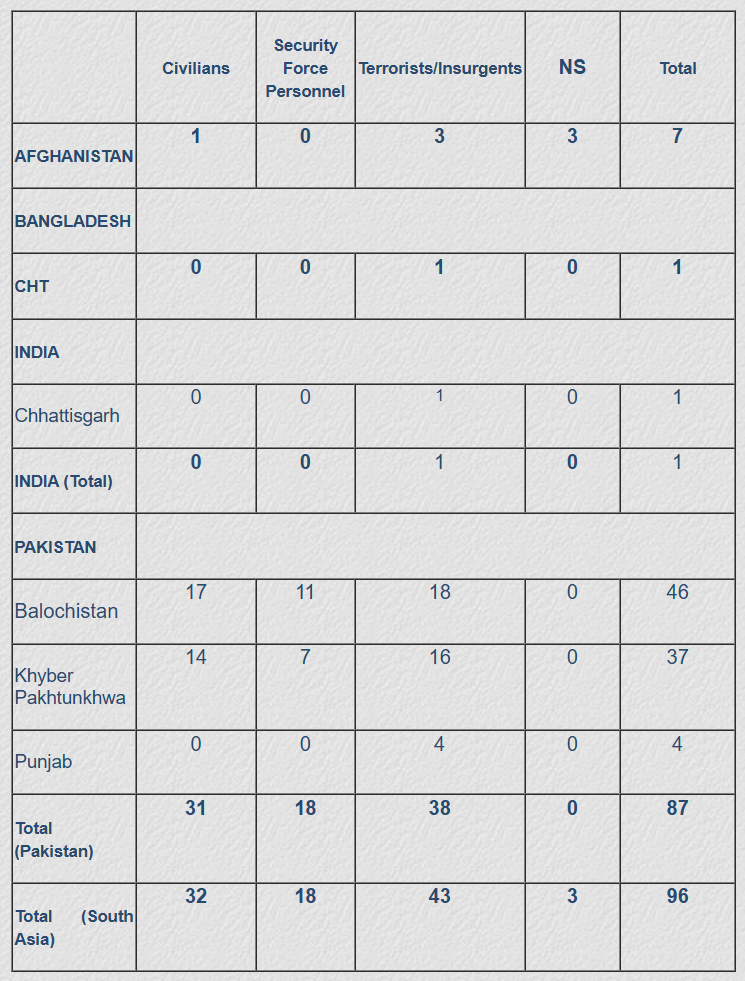
Provisional data compiled from English language media sources.