China & Taiwan Update, February 6, 2026
Toplines
New indicators suggest that CCP General Secretary Xi Jinping launched investigations into two of the seniormost PLA officers because he perceived them as undermining his leadership and military modernization objectives. This is consistent with the assessment that ISW-CDOT published. The PRC announced investigations into Central Military Commission (CMC) Vice Chairman Zhang Youxia and chief of the CMC Joint Staff Department Liu Zhenli on January 25.[1] The CMC is the top military decision-making body in the PRC and operates directly under Xi in his role as CMC chairman. A front-page article in the official PLA newspaper on January 31 reported that the purges of Zhang and Liu reflected efforts to remove political threats and obstacles to “achiev[ing] the centenary goal” of the PLA.[2] That refers to the 2027 PLA modernization objectives, which reportedly includes being prepared to invade Taiwan.[3] The article also emphasized the need to “resolutely obey Chairman Xi’s command, be responsible to Chairman Xi, and reassure Chairman Xi,” implying that Zhang and Liu somehow contradicted him.[4] Another front-page article in the PLA newspaper on February 2 reported that the purges of Zhang and Liu “remove[d] obstacles. . . hindering the development of our cause” and “eliminate[d] the watered-down parts of combat capability building.”[5]
The PLA Daily editorials and other authoritative comments so far have offered no details on Zhang and Liu’s allegedly improper behavior, implying that they are under investigation for political reasons rather than corruption. This contrasts with other investigations into senior PLA officers, such as former CMC members He Weidong and Li Shangfu, whom the CCP explicitly accused of taking bribes, abusing power for personal benefit, and other “job-related crimes.”[6] The CCP has accused Zhang and Liu of fostering the “conditions” for corruption–essentially blaming them for the corruption of others–but stopped short of accusing them of being corrupt themselves. Zhang and Liu may have vocally disagreed with Xi’s military modernization goals or at least failed to adequately implement Xi’s orders for the 2027 modernization milestone.
The CCP held an exchange with the main Taiwanese opposition party, Kuomintang (KMT), for the first time since 2016. This exchange may lead to additional CCP-KMT exchanges and support CCP efforts to co-opt elements of the KMT as a vector for influencing Taiwanese politics. KMT Deputy Chairman Hsiao Hsu-tsen led the delegation to Beijing from February 2 to 4, along with 40 experts from the National Policy Foundation, a KMT-affiliated think tank.[7] A PRC Taiwan Affairs Office (TAO) spokesperson said that the forum was a “starting point” for the resumption of exchanges between the two parties.[8]
TAO Director Song Tao met with the KMT delegation on February 3. Song said that the CCP and KMT have a responsibility to promote cross-strait peace and “safeguard the common family of the Chinese nation.”[9] Song and Hsaio emphasized the importance of opposing Taiwanese independence, upholding the 1992 Consensus, and finding areas of common ground between the PRC and Taiwan. The 1992 Consensus is an alleged verbal agreement between semi-official PRC and ruling KMT representatives that states that both sides agree that there is only one China and that Taiwan is part of that China. The CCP interprets the “one China” to be the PRC, while the KMT interprets it to be the Republic of China (ROC) government in Taipei. The forum concluded with participants presenting 15 shared recommendations for cross-strait cooperation, including tourism, industrial exchange, environmental protection, and disaster prevention.[10] Taiwan’s Mainland Affairs Council (MAC) criticized the recommendations and argued that the CCP was trying to bypass Taiwan’s ruling government and create divisions within Taiwan.[11]
The KMT delegation met with Chinese People’s Political Consultative Conference (CPPCC) Chairman Wang Huning on February 4. Wang is the top CCP official for Taiwan policy other than Xi Jinping. Wang and Hsiao delivered speeches containing standard rhetoric about shared Chinese heritage and values across the strait and reiterating the need to adhere to the 1992 Consensus and oppose Taiwan independence.[12] Hsiao said that both sides of the strait have different interpretations of “one China” under the 1992 Consensus, however.
The CCP likely seeks to legitimize the KMT as an interlocutor on behalf of Taiwan and is therefore pushing for more exchanges with KMT officials.[13] KMT Chairwoman Cheng Li-wun has repeatedly expressed her desire for engagement with CCP General Secretary Xi Jinping and other CCP officials.[14] PRC state media reported positively on Cheng’s cross-strait policies on January 29, saying that she hoped for the KMT to take responsibility for improving cross-strait relations.[15] Hsiao is the primary spokesperson for former Taiwanese President Ma Ying-jeou, whose tenure the CCP has referenced as a model for peaceful cross-strait relations.[16]
Key Takeaways
PLA purges: New indicators suggest that CCP General Secretary Xi Jinping launched investigations into two of the seniormost PLA officers because he perceived them as undermining his leadership and military modernization objectives.
CCP engagement with Taiwan: The CCP held an exchange with the main Taiwanese opposition party, KMT, for the first time since 2016. This exchange may facilitate CCP efforts to co-opt KMT elements as a vector for influencing Taiwanese politics.
Cross-Strait Relations
Taiwan
Taiwanese opposition parties advanced the Taiwan People’s Party (TPP) version of the Special Budget for Asymmetric Warfare to committee review and blocked the Lai administration’s much larger special budget proposal. The TPP version of the bill significantly reduces the arms procurement program in several key areas, including air defense and unmanned systems, compared to the original. The KMT and TPP, which jointly control the Taiwanese legislature, blocked President William Lai Ching-te’s version of the bill for the tenth time on January 30 and voted to bring the TPP version to the Foreign Affairs and Defense Committee for review.[17] The TPP version caps spending at around 13 billion US dollars–a significant decrease from the Lai administration’s 40-billion-US-dollar proposal.[18] The TPP version primarily funds conventional weapons procurements, such as M109A7 self-propelled howitzer, HIMARS, and their munitions.[19] The TPP budget omits funding for the administration’s proposed “T-dome” integrated air and missile defense (IAMD) network and 200,000 drones.[20]
The ruling Democratic Progressive Party (DPP) and Ministry of National Defense (MND) criticized those omissions. The MND repeatedly warned the TPP that its version of the bill only covers a small portion of the requested procurements, which would lead to difficulties in “implementation.”[21] The TPP version of the bill also does not include funds for spare parts and maintenance materials that the United States has already agreed to sell Taiwan.[22] President Lai called the TPP version of the budget “unprofessional” for ignoring MND needs and said that it was irregular for a budget to skip review by the Executive Yuan and advance straight to committee consideration.[23]
The KMT stance toward the TPP budget proposal suggests that its own upcoming version of the budget will likely contain significant cuts in similar areas as the TPP one. The KMT has refused to advance the DPP version of the bill to committee since its December 2 introduction.[24] The KMT voted instead to advance the TPP version of the bill only four days after its introduction.[25] KMT caucus whip Fu Kun-chi said that the KMT is planning to introduce its own version of the special budget.”[26] An opposition special budget that omits funding for unmanned systems and a Taiwanese IAMD network will hinder Taiwan’s planned military modernization. The conflicts in Ukraine and the Middle East have illustrated the effectiveness of IAMD networks in countering sustained missile and drone strikes, a capability that would increase the survivability of Taiwan’s high-end platforms.[27] Unmanned systems would greatly enhance Taiwan’s reconnaissance and precision strike capabilities to target the centers of gravity of a PLA amphibious invasion of the island, such as command and control nodes or the PLA’s limited sealift capacity.[28]
The Taiwanese Navy announced plans to expand its surface fleet by 11 combat vessels and four support vessels by 2040, increasing the Taiwanese surface fleet from 26 to 32 major surface combatants when accounting for likely retirements.[29] The planned expansion would improve the Taiwanese Navy’s ability to respond to PRC coercion and increase the efficacy of its surface fleet in wartime. The Taiwanese Navy announced on February 2 that it plans to procure one Yushan-class landing platform dock (LPD) between 2028 and 2034, five anti-air light frigates and five anti-submarine light frigates by 2040, one submarine rescue and salvage ship between 2027 and 2033, a Panshi-class fast combat support ship between 2027 and 2032, and two rescue ships between 2027 and 2034.[30]The Taiwanese Navy is also planning to produce eight Hai Kun-class attack submarines by 2038.[31] The first vessel of the Hai Kun-class is currently undergoing sea trials.[32]
The planned expansion would enhance the Taiwanese Navy’s ability to resist PRC coercion or a short-of-war blockade. The proposed frigates are lighter than most vessels in their class and Taiwan’s Navy stated that they will perform patrol duties during peacetime.[33] The China Coast Guard (CCG) fields several large vessels comparable to frigates.[34] Modern patrol frigates will allow the Taiwanese Navy to field similarly sized vessels to aid its coast guard in responding to CCG coercion by increasing the number of Taiwanese vessels suitable for expelling larger CCG craft. The Yushan-class LPD likewise fulfills such a role with its large sealift capacity. The Yushan-class can carry dozens of larger vehicles and could resupply Taiwan’s outlying islands if the PRC blockades their ports with CCG, maritime militia, or PLA Navy vessels.[35] The Panshi-class support ship could also resupply Taiwan’s surface fleet at sea, allowing it to maintain a consistent presence around Taiwan in the event of a blockade.[36]
The light frigates may also serve important functions during armed conflict. The air defense frigates will have 32 vertical launch system (VLS) cells able to fire Taiwan’s “Sky Sword II” surface-to-air missile, which can target enemy aircraft and cruise missiles.[37] The anti-submarine variant possesses hull sonar, anti-submarine torpedoes, and depth charges.[38] The shallow draft of the light frigate also allows the vessels to operate close to Taiwan’s coast, enabling them to participate in anti-amphibious landing operations.[39] The frigates will also possess Lockheed Martin’s Combat Management System 330, an advanced information integration system that can coordinate ship-based sensors, soft kill, and hard kill systems across multiple vessels to enhance fleet situational awareness and air defense.[40]
Taiwanese media reported that the funding for the Navy’s procurement plan is in the general budget for 2026, which has yet to pass.[41] Failure to pass the general budget promptly and without significant cuts may delay the Navy’s procurement timeline and hinder the Navy’s efforts to modernize its surface fleet in the next decade.
Taiwan’s Coast Guard Administration (CGA) expanded its list of “suspicious” PRC vessels from 300 to 1,900 after identifying many PRC fishing boats that participated in coordinated drills in December and January. The CGA developed and maintained the list initially to monitor ostensibly civilian vessels in Taiwanese waters possibly involved in sabotaging of undersea cables or other coercive activities for the PRC.[42] The CGA expanded the list following Western media reports that between 1,400 and 2,000 PRC fishing boats mobilized in massive blockade-like formations in the East China Sea on December 25 and January 11.[43] The boats are very likely part of the Chinese Maritime Militia (CMM), which the PRC can mobilize to support coercion, sabotage, blockade, and invasion operations against Taiwan. Taiwan has been improving its monitoring and countermeasures against such so-called “gray-zone activities” in recent years, especially after suspected PRC fishing boats and cargo ships severed some of Taiwan’s undersea internet cables in 2023 and 2025.[44]
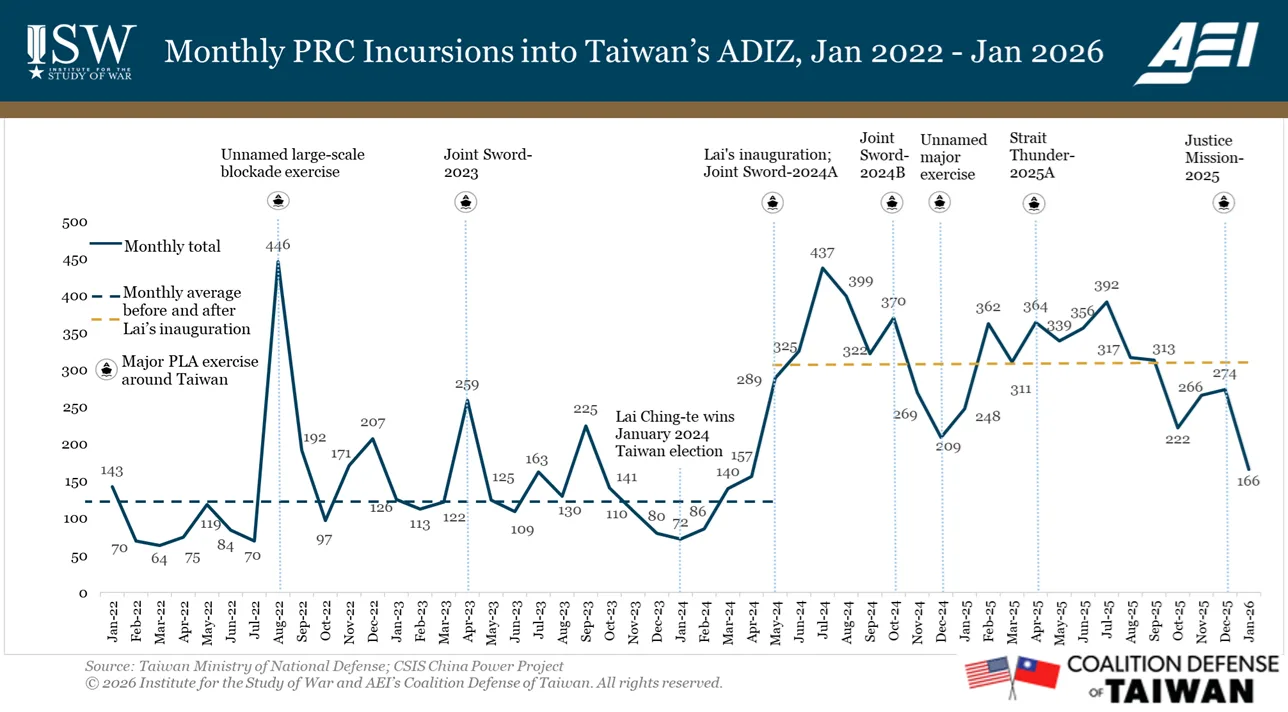
PLA sorties into Taiwan’s Air Defense Identification Zone (ADIZ) in January 2026 declined to their lowest monthly volume since before President Lai’s inauguration. The PLA flew 166 sorties across the median line in the Taiwan Strait in January, the first time since April 2024 that the number of monthly ADIZ incursions have been lower than 200.[45] The unusually low total is still directionally consistent with a seasonal decline in ADIZ incursions each winter since 2023, however.
The PLA’s ADIZ incursion volume has averaged over 300 per month since Lai took office, twice the monthly average compared to the previous two years. The DPP’s China Affairs Department released a report that found PLA air incursions around Taiwan have risen from 380 in 2020 to 5,709 in 2025, an increase of nearly 15 times in five years.[46] The PRC has normalized a high volume of aerial sorties near Taiwan to erode Taiwan’s threat awareness and signal its displeasure with political developments in Taiwan, such as the election of DPP presidents. The high volume of “normal” ADIZ incursions has forced Taiwan to raise its threshold for mobilizing a military response or triggering air raid sirens.[47]
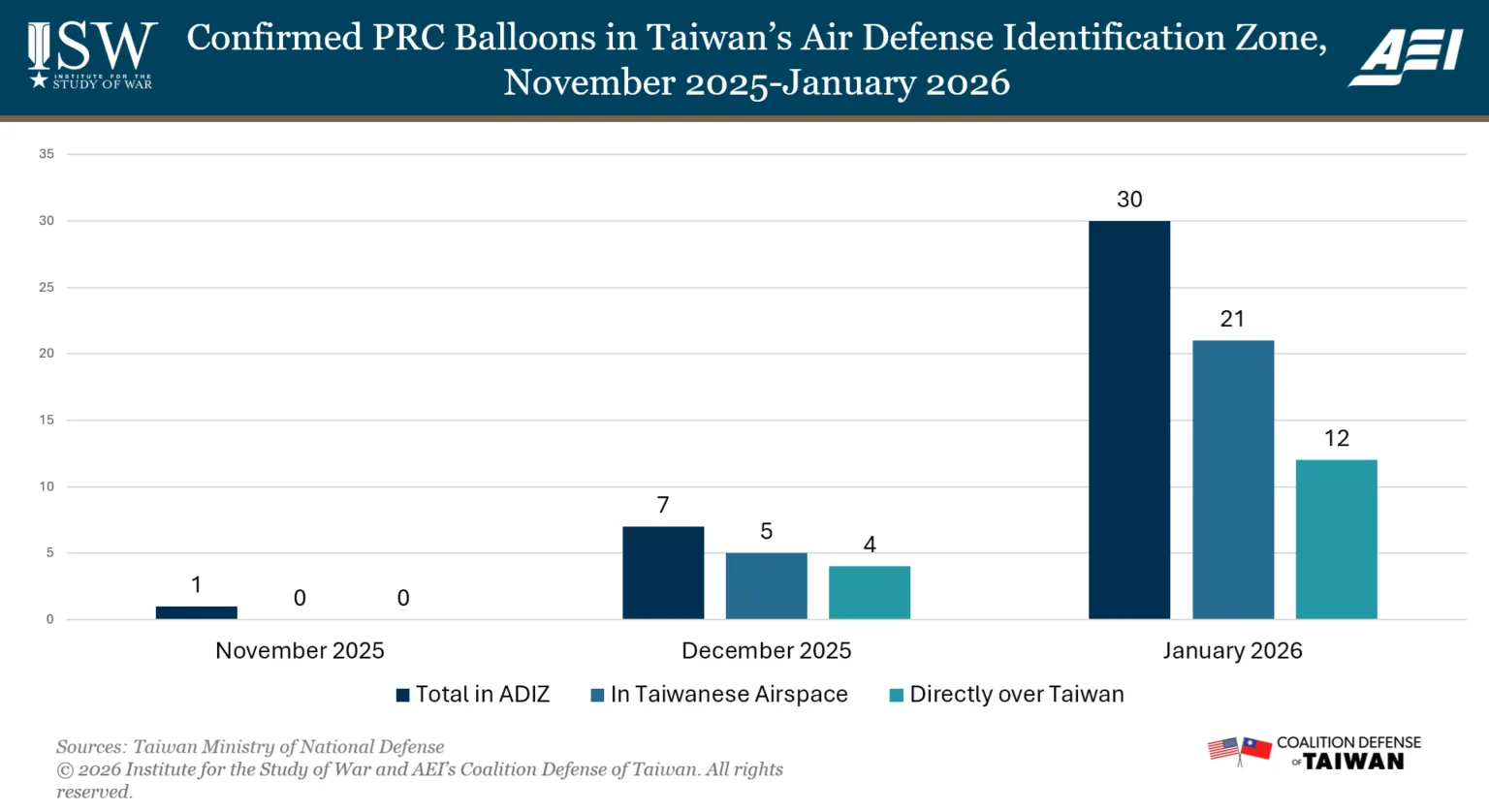
The PRC sent 30 high-altitude balloons into Taiwan’s ADIZ in January, including at least 21 that flew through Taiwan’s territorial airspace. At least 12 of the balloons flew directly over Taiwan’s land territory, according to maps released by Taiwan’s MND.[48] The MND began reporting these balloon incursions in its daily ADIZ reports in the winter of 2023–2024, when the volume of balloons appears to have dramatically escalated. The timing appears connected to Taiwan’s 2024 presidential and legislative elections. The PRC sent high-altitude balloons over and around Taiwan every winter since then, albeit at lower volumes.
The balloons likely carry meteorological monitoring and surveillance equipment. The PRC has claimed that they are weather balloons launched “mostly” by commercial entities, but the balloons fly lower than most atmospheric monitoring balloons and likely serve surveillance and cognitive warfare functions.[49] The balloons also erode Taiwan’s threat awareness and test Taiwan’s responses, similar to other ADIZ incursions, while flying high enough and being “unthreatening” enough that they can fly over Taiwan without triggering military escalation, unlike piloted aircraft.
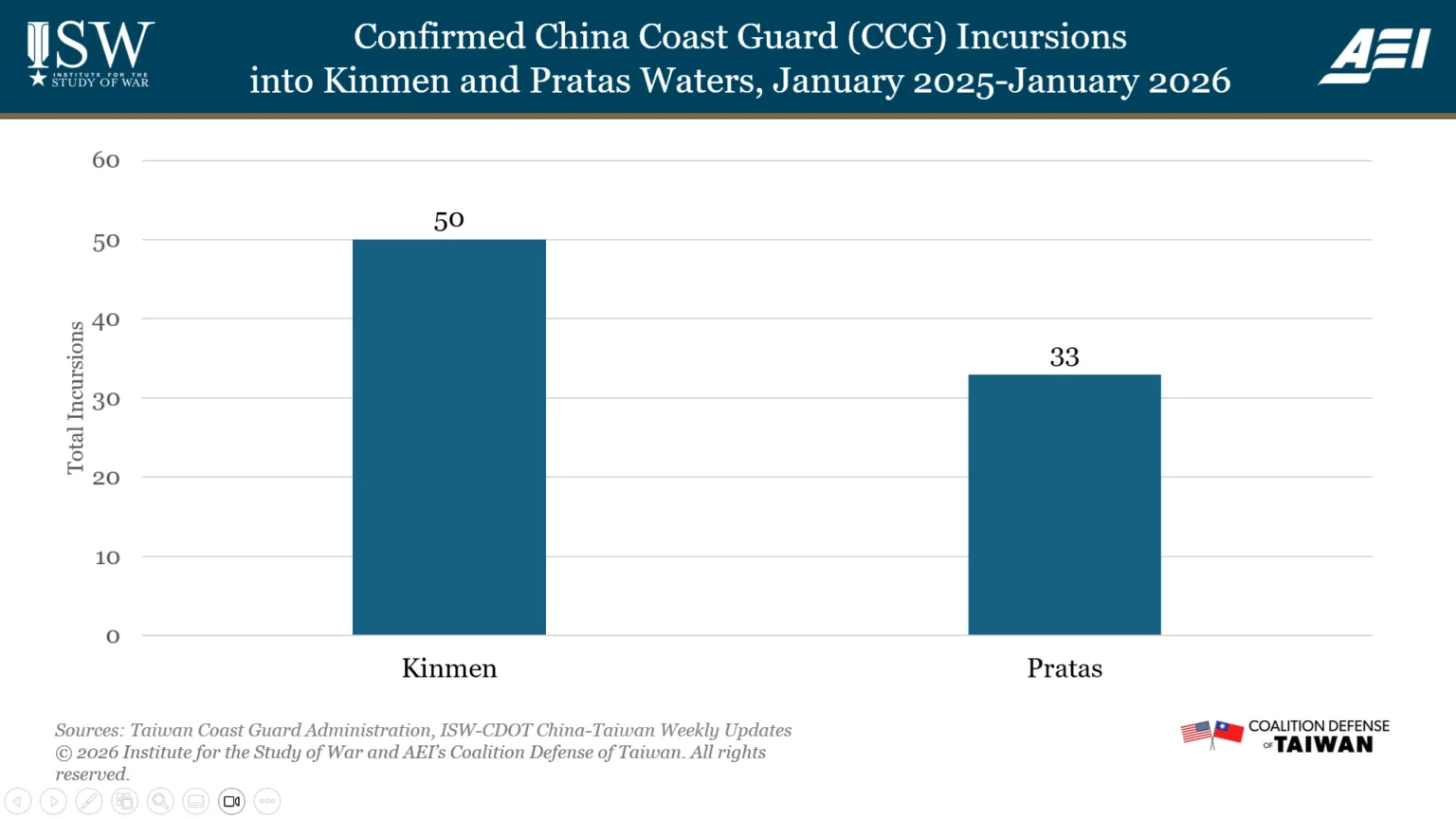
The CCG conducted four incursions into waters around Taiwan’s Kinmen islands and one around Taiwan’s Pratas Island in January, consistent with the patrol frequency it has normalized in recent years to erode Taiwan’s sovereignty. Four CCG ships patrolled in the restricted waters of Kinmen on January 6, 14, 19, and 24. Kinmen is a Taiwanese archipelago and county located about two miles from the PRC. One CCG ship conducted a 24-hour patrol around Pratas Island on January 15 within the island’s contiguous zone. Pratas is a Taiwanese atoll with a coast guard and marine garrison but no permanent population, located north of the South China Sea. CCG patrols in Taiwanese-administered waters aim to erode Taiwan’s sovereignty and threat awareness, especially around Taiwan’s outlying islands. They also set conditions and drill capabilities for a possible future blockade of the islands. The PLA additionally flew a surveillance drone through Pratas airspace for the first time on January 17, possibly the first confirmed violation of Taiwanese airspace by a PLA aircraft.[50] The PLA and CCG will likely escalate coercive tactics in Taiwan-administered sea and airspace in 2026.
China
CCP General Secretary Xi Jinping had calls with Russian President Vladimir Putin and US President Donald Trump on January 4. Xi first held a video call with Putin, readouts of which included standard rhetoric.[51] The two leaders discussed the strength of Russia-PRC ties, and Xi advocated for maintaining bilateral discussions and cooperation.[52] Putin accepted an invitation to visit the PRC within the first half of 2026.[53] Russia’s statement on the call similarly emphasized strong bilateral ties and noted the PRC and Russia’s efforts to create a visa-free regime.[54] The PRC has maintained a neutral stance since Russia’s full-scale invasion of Ukraine in 2022, seeking to portray itself as a third-party mediator. PRC Foreign Affairs Minister Wang Yi reportedly told EU High Representative for Foreign Affairs and Security Policy Kaja Kallas that the PRC wants Russia to not lose the war, however.[55]
Xi spoke to Trump on the phone hours after speaking to Putin. Xi “emphasized that the Taiwan question is the most important issue in China-US relations” during his call with Trump, per a PRC Ministry of Foreign Affairs (MFA) readout.[56] The MFA readout stipulated that the United States “must handle arms sales to Taiwan with extreme caution,” echoing previous PRC warnings against US arms sales to Taiwan.[57] Trump said he also discussed Iran and trade issues during the call with Xi.[58] Kremlin spokesman Dmitry Peskov reportedly said Russia knew beforehand that Xi would speak with Trump, indicating the calls were likely planned for the same day intentionally.[59] Trump said that he plans to visit the PRC in April, but PRC officials have not yet confirmed this.[60]
The calls took place shortly before the February 5 expiration of the New START nuclear arms control treaty between Russia and the United States.[61] Russian media reported that Xi and Putin discussed the ending of the treaty “in terms of its negative consequences for strategic stability.”[62] Trump expressed interest in drafting a different arms control treaty, potentially including the PRC, following New START’s expiration.[63]
The PRC reportedly permitted three major technology companies to import a limited amount of H200 semiconductor chips from US semiconductor manufacturer Nvidia. The PRC’s allowance of limited imports suggests that it will attempt to use the H200 to improve its own AI and chip manufacturing capabilities without becoming reliant on US technology. Reuters cited anonymous sources on January 28 who claimed the PRC will allow ByteDance, Alibaba, and Tencent to import over 400,000 H200 chips.[64] Reuters also reported that the PRC directed the approved companies to import the H200 only when necessary.[65] The H200 is Nvidia’s second most advanced chip and outclasses the PRC’s domestically produced models in processing power.[66] The Trump administration lifted restrictions on H200 exportations to the PRC on December 8.[67] The United States has restricted advanced chip sales to the PRC due to their critical role in training AI models that the PRC could use to surpass US AI capabilities, including in military applications.[68] Nvidia CEO Jensen Huang and other proponents of exporting advanced US chips to the PRC have argued that the PRC would remain reliant on US semiconductor technology, however.[69]
The PRC has worked to build its own chip industry and reduce its reliance on foreign supply chains since at least 2014. PRC tech company Huawei announced in September 2025 that it aimed to triple its domestic chip production in 2026.[70] PRC regulators may have allowed limited imports of H200 chips so that the PRC can reap the benefits of the more advanced Nvidia technology in the short term without significantly undermining its long-term drive for self-sufficiency.
The Financial Times reported on February 3 that the US Department of State held up the sale of the H200 chips to the three PRC companies to allow for a stringent security review.[71] Financial Times also reported that the State Department is pushing for unspecified regulations on the exports that would limit the PRC’s ability to use the chips in ways that undermine US national security.[72] More stringent security measures that condition licensing agreements for the H200 chips exported to the PRC could mitigate the impact the H200 will have on improving the PRC’s AI development and its military applications.
A US federal jury convicted a former Google software engineer of economic espionage on January 29 for stealing trade secrets related to artificial intelligence (AI) technology for the PRC.[73] The US District Court for the Northern District of California found that Leon Linwei Ding downloaded over two thousand pages of Google’s trade secrets to his personal laptop just before resigning from his position at Google in December 2023.[74] Ding applied for a PRC-sponsored talent-recruitment program, stating that he planned to help develop the PRC’s computing power infrastructure.[75] The PRC uses talent-recruitment plans to leverage foreign technological innovations and expertise for its own economic and military benefit, often by stealing foreign trade secrets and intellectual property.[76]
The court also found that Ding intended to assist two PRC government-controlled entities in developing an AI supercomputer and carrying out research and development on machine learning chips.[77] Ding stole technical information on the chip architecture and software used in these advanced semiconductor chips used for training AI models.[78] The PRC views AI as critical for its national security and military modernization and is pursuing national “self-reliance” at all levels of the AI development process. The PRC’s lagging capabilities in AI training chip architecture and software have slowed its progress towards this goal, however.[79] The PRC can take advantage of civilian technological advances to enhance its military through the Military-Civil Fusion strategy.[80]
The PLA may be producing stealth fighter jets with improved, domestically produced engines that would allow them to achieve supersonic flight without the use of afterburners. This capability would bring the PLA’s J-20 closer to the standards of US fifth-generation fighters. The PRC’s state broadcasting service CCTV released footage of a new variant of the J-20 fighter, the J-20A, undergoing test flights on January 25.[81] Hong Kong news outlet South China Morning Post speculated that the footage showed the J-20A had a new engine, possibly the PRC-produced WS-15.[82] The J-20s currently in service use the less powerful WS-10, which the PLA has been aiming to replace with the WS-15 for over a decade.[83] The WS-15’s enhanced thrust would likely allow the J-20 to achieve supersonic (Mach 1+) flight without the use of afterburners, a capability known as “supercruise,” greatly enhancing the fighter’s fuel efficiency and operating range.[84] Supercruise is one of the major benchmarks for considering an aircraft to be a fifth-generation asset.[85] The US Air Force’s principal fifth-generation air superiority fighter jet, the F-22 Raptor, is capable of supercruise and can reach speeds of Mach 1.5.[86]
The PLA appears to be prioritizing upgrades to speed and combat range for its aircraft to present a greater challenge to the US Air Force in the Indo-Pacific. The WS-15 would mark a significant milestone for the PLA Air Force (PLAAF), which has historically relied on Russian-produced and Russian-derived systems, including the first engines to outfit the J-20 fighter.[87] The PLA is also developing air-to-air missiles that outrange US systems without jeopardizing the stealth of the J-20. The PLA’s PL-15 and PL-17 have ranges up to 300 to 400 kilometers, far outranging the US Air Force’s AIM-120D’s approximately 160-kilometer maximum range.[88] The PL-15 and PL-17 are mounted on hardpoints beneath the wings of the J-20, however. This significantly increases the plane’s radar cross section and thus reduces its ability to avoid radar detection.[89] The PLA is developing the PL-16 missile, which may solve this problem, as the PL-16 has a similar range to the PL-15 and can fit in the internal weapons bay of the J-20.[90]
A PLA stealth fighter capable of supercruise and equipped with long-range, stealth-compatible missiles would likely be the most serious threat the US Air Force faces in the next decade. The longer ranges of PLA aircraft and aerial weaponry could allow the PLAAF to target US support aircraft, such as its airborne early warning and control (AEW&C) systems, to mitigate the effectiveness of US combat aircraft operating in the region.[91] It is unclear whether the PLA fields the necessary radar and information processing technology to reliably execute a long-range kill chain of this sort, however.
Northeast Asia
Japan
The PRC’s suspension of exports of dual-use goods to Japan has prompted Japan to search for alternative sources of rare earths. The PRC suspended the export of dual-use goods, including some rare earths, to Japan on January 6.[92] The PRC’s restrictions are part of a broader campaign to punish Japan in response to Japanese Prime Minister Sanae Takaichi’s statement on Taiwan in November 2025, and to pressure Takaichi to retract the statement. Takaichi’s statement suggested that the Japan Self- Defense Force might mobilize in response to a PRC invasion against Taiwan.[93] This is the second time that the PRC has imposed a major export restriction on rare earths exports to Japan. Japan has been seeking to reduce its reliance on the PRC for rare earth minerals since the PRC briefly restricted rare earth exports to Japan in 2010 due to a dispute over the Senkaku Islands.[94] Japan’s rare earth imports from the PRC have since dropped from 90 percent to 60 percent.[95] Japan also recently signed an agreement with the United Kingdom to accelerate cooperation on the critical minerals supply chain, and began exploring deep-sea mining to increase domestically produced rare earths.[96]
The PRC is using economic pressure and propaganda to foment and amplify domestic Japanese opposition to Takaichi. PRC state media on January 31 quoted individuals in the Japanese business community that criticized Takaichi for negatively impacting Japan’s economy by doing “unnecessary things” and “overstimulating” the PRC.[97]
North Korea
Nothing Significant To Report.
South Korea
Nothing Significant To Report.
Southeast Asia
Philippines
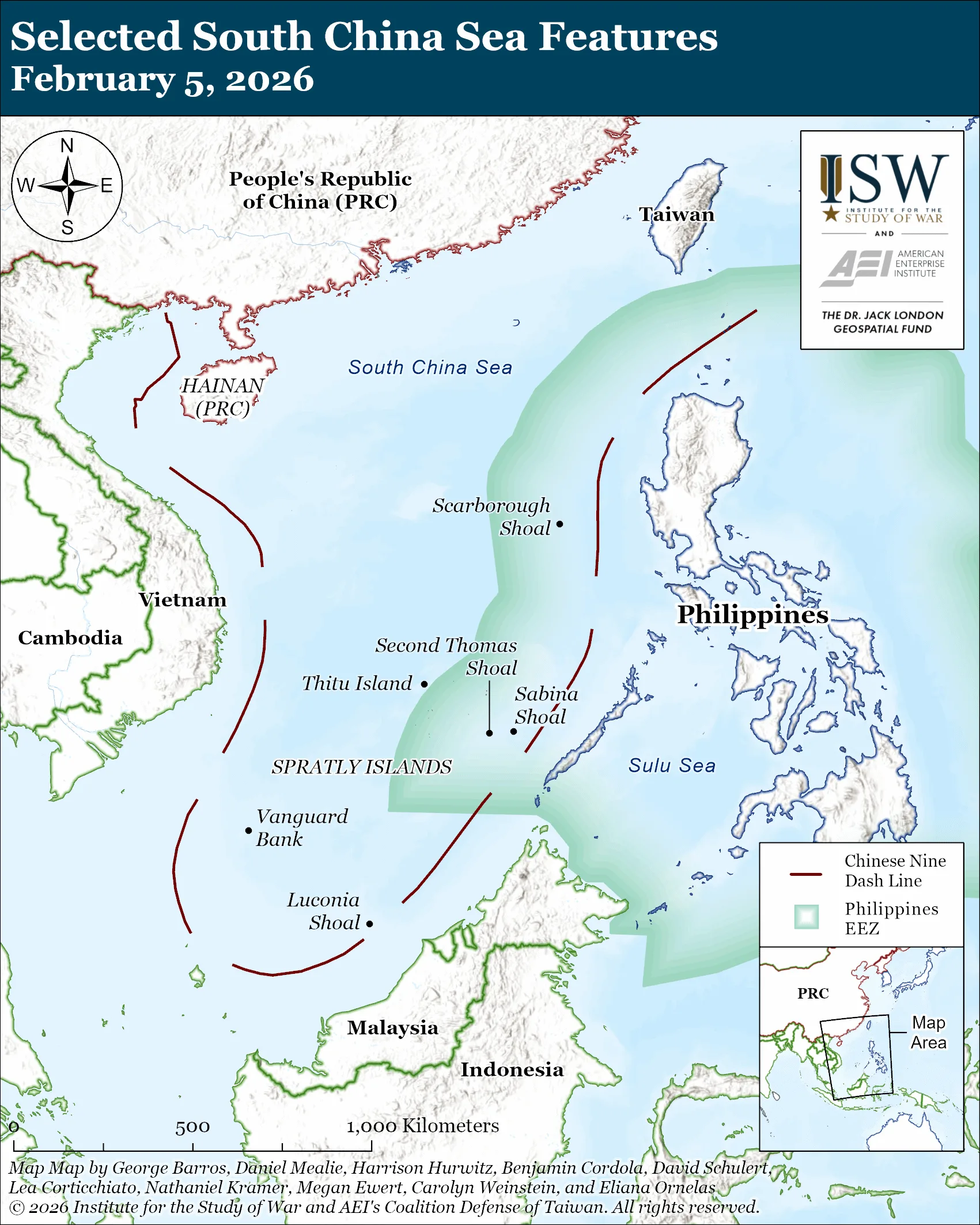
A January 29 Center for Strategic and International Studies (CSIS) report revealed that CCG activity around Scarborough Shoal and Sabina Shoal significantly increased in 2025. The PRC is likely increasing its presence around disputed South China Sea features to bolster its territorial claims. CSIS’s Asia Maritime Transparency Initiative (AMTI) examined automatic identification system (AIS) data from 2025 to measure the number of days that CCG vessels patrolled near Luconia Shoal, Sabina Shoal, Scarborough Shoal, Second Thomas Shoal, Thitu Island, and Vanguard Bank, six disputed South China Sea features.[98] AIS is a system that broadcasts a ship’s location and other data. AMTI reported that in 2025, CCG patrols around Sabina Shoal and Scarborough Shoal increased to 405 ship days, defined by AMTI as the sum of each day spent by a CCG vessel at each location, and 1099 ship days, respectively, compared to 139 and 516 in 2024. Both shoals have been the sites of confrontations between PRC and Philippines vessels in recent years. All other features that AMTI examined experienced a decreased CCG presence in 2025 compared to 2024. AIS data presents an incomplete picture of PRC activity, however, because CCG ships sometimes disable AIS, and CMM boats often lack AIS completely. The CMM maintains a significant presence around disputed South China Sea features, particularly around Sabina Shoal.
The PRC has occupied Scarborough Shoal since 2012, using primarily CCG ships and frequently preventing Philippine sailors from sailing near PRC “sovereign territory.” The PRC solidified its territorial claims by establishing a nature reserve at Scarborough Shoal in September 2025 and maintained a constant presence of CCG and CMM vessels, often supported by PLA Navy ships.[99] ISW-CDOT previously assessed that the PRC likely aims to deny the Philippines access to Sabina Shoal too, as the Philippines uses the Sabina Shoal as a staging ground for resupply missions to the Spratly Islands.[100] The PRC has not built infrastructure at either Scarborough or Sabina Shoal, though the Philippines pointed to crushed coral at Sabina Shoal in 2024 as possible evidence of preliminary PRC island-construction activities.[101] The PRC’s increased CCG presence in Sabina Shoal in 2025 is likely intended to bolster PRC territorial claims and potentially lay the groundwork for the PRC assuming de facto control of the shoal.
Europe
PRC state media is portraying UK Prime Minister Keir Starmer’s visit to Beijing very positively, even publishing articles to defend Starmer from Western critics, likely to spread narratives portraying the PRC as a reliable trading partner and ally, implicitly in contrast to the United States. British Prime Minister Keir Starmer visited Beijing from January 28 to January 31 and met with the three top CCP officials: General Secretary Xi Jinping, Premier Li Qiang, and Chairman of the Standing Committee of the National People’s Congress Zhao Leji.[102] This is the first visit by a British Prime Minister since Theresa May in 2018.[103] PRC state media Xinhua published an article that listed 11 positive outcomes of Starmer’s visit, which included strengthening bilateral trade and the PRC considering allowing UK citizens visa-free access to the PRC.[104]
Starmer stated prior to his meeting with Xi that “it is in our national interest to engage with China” and his administration has pursued policies that would deepen bilateral economic relations.[105] Xinhua published an article following Starmer’s visit claiming that the United Kingdom’s “ostrich policy” that purposefully distanced itself from the PRC caused the UK to miss out on development opportunities.[106] Commentators in PRC state media repeatedly praised deepening cooperation with the UK.[107] Xinhua also published a commentary article framing the first Canadian and UK Prime Ministers’ visits to Beijing in many years, both in January 2026, as a sign of Western countries’ appreciation for the PRC as a global power.[108]
The PRC is emphasizing its closeness with the United Kingdom and Canada to highlight its increased diplomatic strength and ability to draw in traditionally US allies. The UK’s opposition Conservative Party and other critics have criticized Starmer for amplifying PRC narratives portraying itself as a reliable trading partner in contrast to the United States, and for insufficiently addressing concerns over PRC espionage and human rights abuses.[109] PRC state media defended Starmer by calling the backlash predictable and driven by partisan rivalry.[110]
Latin America
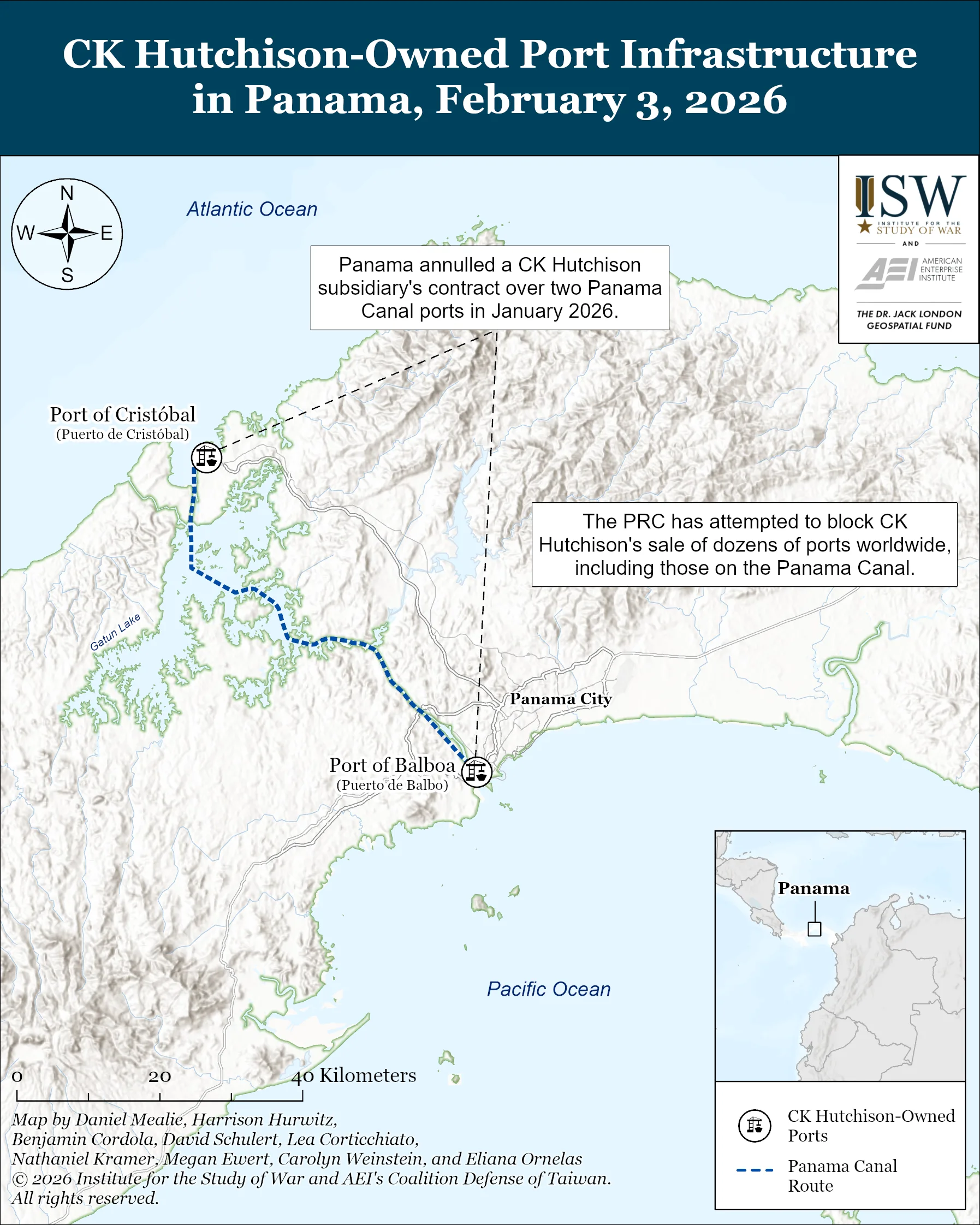
The Panamanian Supreme Court canceled Hong Kong-based CK Hutchison’s contracts to operate ports on the Panama Canal. The PRC will likely continue to seek legal recourse to maintain a foothold in the canal, however. The court ruled the concessions unconstitutional on January 29, citing audit irregularities in its decision.[111] CK Hutchison’s subsidiary Panama Ports Company, which operated two ports on opposite ends of the canal, initiated arbitration proceedings to challenge the decision on February 3.[112] The ports will reportedly continue to operate despite legal proceedings.[113] Panamanian President Jose Raul Mulino stated on February 5 that no single company is permitted to operate the ports going forward, with Panama Ports Company continuing to manage the ports until the court’s ruling takes effect.[114] A unit of shipping company A.P. Moller-Maersk will temporarily manage the ports following the loss of CK Hutchison’s license, after which Panama will initiate a bidding process for other interested firms.[115]
The PRC condemned the Panamanian court’s decision. The PRC’s Hong Kong and Macau Affairs Office posted on social media that Panama risked incurring “heavy prices both politically and economically.”[116] PRC MFA spokesperson Guo Jiakun said that the PRC would take all “necessary measures” to protect its economic interests in a February 2 press conference.[117] The PRC has sought to deepen its involvement in Latin American infrastructure, largely via its shipping company COSCO, which holds a 60 percent stake in the newly-constructed Chancay “megaport” in Peru.[118]US officials have expressed concern regarding PRC influence and access in Latin America, including over the strategically critical Panama Canal. US Secretary of State Marco Rubio warned Panamanian authorities to reduce PRC influence over the canal during his visit to Panama in February 2025.[119] US Senator Ted Cruz in 2025 expressed concern about the two ports and a partial bridge over the canal, stating that “The partially-completed bridge gives China the ability to block the canal without warning, and the ports give China ready observation posts to time that action.”[120] Blocking the Panama Canal would severely damage US maneuverability and trade via a critical chokepoint through which the United States ships millions of long tons of cargo per year.[121]