
China & Taiwan Update, March 1, 2026
Toplines
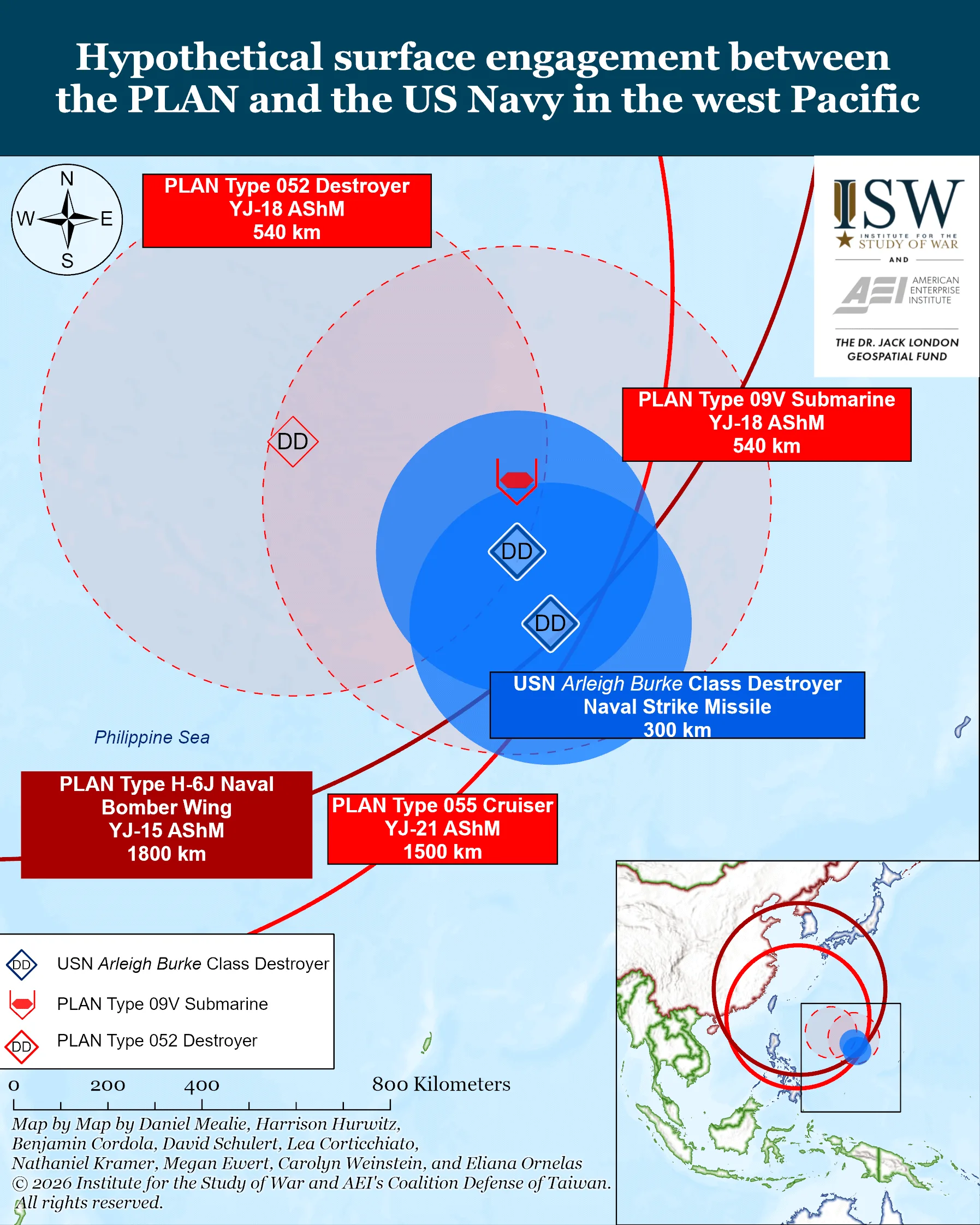
The People’s Liberation Army Navy (PLAN) may be preparing to launch its first Type 09V guided missile nuclear submarine (SSGN). The Type 09V is an improvement to PLAN undersea capabilities and could enhance the PLAN’s ability to deter the movement of a US surface fleet in the western Pacific during a Taiwan contingency. UK defense magazine Janes reported that satellite imagery on February 9 revealed that the first Type 09V SSGN was moved into the launch bay of the Huludao shipyard in the PRC’s Liaoning Province.[1] Both Janes and maritime analysis website Naval News obtained unpublished high-resolution satellite imagery that revealed key details about the Type 09V. The new SSGN features an “X-stern” rudder, which enhances the submarine’s maneuverability and marks a shift from the cruciform rudders found on other PLAN submarines.[2] The Type 09V is also larger than the previous PLAN SSGN model, the 7,000-ton Type 09III, displacing between 1,000 and 2,000 more tons.[3] Naval News’s high-resolution imagery showed space behind the Type 09V’s dorsal sail for 18 vertical launch system (VLS) cells.[4] These cells would likely fire anti-ship or land attack cruise missiles, such as the PLAN’s YJ-18.[5]
The Type 09V SSGN would play a unique role in PLAN operations due to the presence of VLS cells on a submarine that does not form part of the PRC’s nuclear triad. Submarines capable of launching anti-ship missiles have a distinct advantage in modern surface combat because contemporary anti-ship missiles outrange a surface fleet’s organic anti-submarine warfare (ASW) capabilities.[6] This allows SSGNs to fire their anti-ship armament from closer ranges without risking retaliatory strikes in comparison to a surface vessel. SSGNs can, as a result, rapidly increase the firepower of an existing missile salvo launched from stand-off ranges, which in turn decreases the amount of time an enemy fleet has to react to that salvo.[7]
The PLAN’s introduction of a new SSGN diversifies the range of threats that the US Navy would face in the western Pacific during a Taiwan contingency. The PLA currently fields long-range, anti-ship capabilities on the surface, in the air, and on land, which make fleet air defense a complicated and taxing endeavor for a surface fleet operating between Guam and Taiwan.[8] The Type 09V illustrates the PLAN’s intention to add a long-range undersea component to this existing network that will enhance the PLAN’s ability to target enemy surface fleets from stand-off distances in multiple domains.
The Supreme Court (SCOTUS) ruled on February 20 that the president cannot levy tariffs under the International Emergency Economic Powers Act (IEEPA), a law the Trump administration has invoked extensively since April 2025 to impose tariffs on many countries without Congressional approval.[9] This decision does not affect presidential tariff powers under the 1974 Trade Act and other laws, however. Trump signed an executive order shortly after the Supreme Court decision to levy a temporary 10-percent tariff on most imported goods under Section 122 of the Trade Act, which took effect on February 24 and will expire after 150 days.[10] Trump later said that he would raise the tariff to 15 percent–the maximum allowed under Section 122–but has signed no order to do so at the time of writing.[11]
The SCOTUS decision came weeks after US and Taiwanese officials signed the Agreement on Reciprocal Trade (ART) on February 12, in which the United States agreed to lower tariffs on Taiwan to 15 percent in exchange for Taiwan eliminating or reducing tariffs on nearly all US goods and boosting purchases of US natural gas and other goods.[12] Taiwan’s Legislative Yuan (LY) must still ratify the agreement, however. The opposition Kuomintang (KMT) and Taiwan People’s Party (TPP), which jointly hold a majority in the LY, called for the government to renegotiate the ART in response to the SCOTUS decision and new Section 122 tariffs.[13] Taiwanese President William Lai Ching-te reportedly said that the ART is favorable to Taiwan and that the LY should approve it quickly, however.[14] Other Taiwanese officials said the SCOTUS decision and new tariffs would have a limited impact on Taiwan, but they would seek clarification from Washington.[15]
The new restriction on President Trump’s ability to quickly and unilaterally impose tariffs may defuse arguments by the CCP and some Taiwanese opposition figures that the United States is an unreliable partner for Taiwan. Trump imposed a 32 percent tariff on Taiwanese goods in April 2025, later negotiated down to 20 percent, which notably harmed US-Taiwan relations and fueled opposition criticisms that President Lai’s pro-US policies don’t benefit Taiwan.[16] The tariffs also fueled arguments from Taiwan’s opposition parties and the CCP that the United States is an unreliable partner for Taiwan. PRC state-owned tabloid Global Times claimed on February 24 that the recent changes in US tariff policy caused “intense backlash” against Taiwan’s ruling Democratic Progressive Party (DPP) for “selling out” Taiwan.[17] The CCP seeks to undermine Taiwan’s faith in the United States as a security guarantor to weaken the US-Taiwan relationship and encourage Taiwan to move toward unification with the PRC. The US Supreme Court’s decision may defuse these arguments by making US trade policy toward Taiwan more stable and predictable in the long run.
Key Takeaways
PLA Nuclear Submarine Development: The PLAN may be preparing to launch a new type of guided missile nuclear submarine (SSGN). This submarine would improve PLAN undersea warfare capabilities and enhance the PLAN’s ability to restrict the movements of enemy surface fleets in the western Pacific during a Taiwan contingency.
US Tariffs: The Supreme Court ruled that the president cannot levy tariffs under the International Emergency Economic Powers Act (IEEPA), a law the Trump administration has invoked extensively since April 2025 to impose tariffs without Congressional approval on many countries, including Taiwan and the PRC.
Cross-Strait Relations
Taiwan
Taiwan’s Legislative Yuan (LY) will review all versions of the special defense budget on March 6, possibly including a forthcoming KMT version. Taiwan must approve three US weapons packages by March 15, requiring quick legislative action from the LY to allocate funding for the purchase. The LY’s Foreign Affairs and National Defense Committee and Finance Committee are scheduled to review all versions of the special defense budget, including the ruling DPP’s original 1.25 billion New Taiwan dollar version (about 40 billion US dollars), the TPP’s 400 million New Taiwan dollar version (about 12.7 billion US dollars), and a forthcoming KMT version.[18] The opposition KMT and TPP have criticized the government-proposed version of the bill for lacking transparency and detail, and all versions of the special defense budget will be on the March 6 agenda.[19] The KMT is reportedly facing internal divisions over whether to support the government-proposed budget.[20]
Taiwan faces a March 15 deadline to sign three US arms packages to purchase advanced weapons systems.[21] Taiwanese Defense Minister Wellington Koo requested the LY give the defense ministry the authority to sign for the arms packages on February 24, as failing to sign them on time would result in the deals’ cancelation.[22] The special defense budget may not be finalized in time for the March 15 deadline, even if the LY approves the special defense budget as is, which could result in Taiwan losing access to weapons due to domestic political gridlock for the first time.[23]
China
The Wall Street Journal (WSJ) cited unnamed CCP insiders who said that the CCP’s large-scale military purges since 2023 were at least partially spurred by Russia’s experience with military corruption and disloyalty. CCP General Secretary Xi Jinping has very likely elevated the importance of political loyalty in evaluating the PRC’s military readiness. The CCP conducted a series of high-level purges of military leadership since 2023, which removed most of its top military commanders and likely ensnared nearly 100 generals in anti-corruption investigations.[24] The WSJ cited unnamed “people close to [CCP] decision-making” who said that CCP leaders worried about corruption and disloyalty similar to what Russia experienced in Ukraine.[25] The WSJ noted that the 2023 wave of purges in the PLA began shortly after Wagner Group chief Yevgeny Prigozhin mutinied against Moscow. The unnamed CCP insiders said that Russia’s failure to quickly defeat Ukraine and Prigozhin, despite expensive military modernization efforts, showed Xi Jinping the necessity of absolute political loyalty in ensuring military success.
Russia’s costly failures in Ukraine may have caused Xi to consider political loyalty as a key measure of military preparedness, and thus reduced his evaluation of the PLA’s readiness to annex Taiwan. Xi’s military purges since 2023 have included people he promoted himself and people widely believed to be part of his inner circle, suggesting that he has become more paranoid about disloyalty.[26]
The WSJ also reported new details about the arrest of Central Military Commission (CMC) Vice Chair Zhang Youxia in January, citing the same unnamed insiders. The CCP announced disciplinary investigations into Zhang and fellow CMC member Liu Zhenli on January 25, functionally removing them from office.[27] The CCP has reduced the CMC, its top military decision-making body, from seven members to two since 2023. WSJ said that Xi quietly replaced Beijing’s head of security with a People’s Armed Police officer loyal to him — breaking with the tradition of appointing an army officer to the job — days before he sent security forces to arrest Zhang on January 19. Security forces also arrested Zhang’s son and likely arrested Liu Zhenli around the same time, since neither Zhang nor Liu appeared at an important CCP political study session on January 20. Official sources have not confirmed Zhang or Liu’s arrest or clarified their alleged misdeeds, though the PLA’s official newspaper accused them of “trampling” on Xi’s leadership of the CMC.[28] The details of Zhang’s alleged arrest strengthen ISW-CDOT’s assessment that Xi ordered the recent purges to remove rival power centers and solidify his political control.
Northeast Asia
Japan
Japan may be working toward improving its ability to intercept large swarms of unmanned systems to enhance its overall air defense network. Improvements in this area would allow Japan to withstand PRC coercive or military efforts to prevent Japan from intervening in a Taiwan contingency. Japanese media cited unnamed government sources on February 21 who claimed that the government was planning to enhance Japan’s multi-layered air defense network to include systems dedicated to countering large drone swarms.[29] The unnamed sources claimed this improvement was a part of Japanese Prime Minister Sanae Takaichi’s broader effort to revise Japan’s National Security Strategy, National Defense Strategy, and Defense Buildup Program.[30] Japanese media stated that the government was considering investing in laser systems and microwave systems that could engage multiple aerial targets.[31] Japan currently intends to use its domestically developed Type 03 Medium-Range Surface-to-Air Missile for drone interception, despite the system being designed to engage aircraft and cruise missiles.[32] Investing in energy weapons would likely provide Japan with a more cost-effective method to target large groupings of unmanned systems.
The PRC could deploy drones, including in a swarm configuration, during a coercion or military campaign against Japan to dissuade or prevent its intervention in a Taiwan contingency. ISW-CDOT previously assessed that the PLA is enhancing its efforts to integrate unmanned systems of various types into its operating concepts.[33] The PRC has previously deployed drones as part of its coercion campaign against Taiwan.[34] PRC state broadcasting service CCTV released a video on February 22 that showcased the PRC’s National University of Defense Technology’s drone program and its heightened emphasis on creating the technological infrastructure for swarm technology.[35] The PRC could use drone swarms to overwhelm Japanese air defenses, especially around key military infrastructure, such as ports, airfields, or radar installations close to the PRC. Producing systems dedicated to intercepting large swarms of drones would improve Japan’s ability to withstand such an attack.
The PRC has used political, economic, and military coercion, including the deployment of the aircraft carrier Liaoning, to pressure Takaichi to recant comments that Beijing interpreted as signaling Japan’s likely involvement in a Taiwan contingency. Takaichi remarked in November 2025 that a PRC invasion of Taiwan could constitute a national crisis that necessitates the deployment of Japan’s Self-Defense Force.[36] The PRC is likely concerned that Japanese involvement in a Taiwan contingency would significantly complicate any effort to invade or blockade Taiwan.
Takaichi won a snap election with landslide support on February 8 amid PRC demands for her to retract her statements, signaling popular support for Takaichi to pursue her defense-focused agenda.
The PRC continues its use of economic coercion against Japan to force Takaichi to retract her statements on Taiwan, despite her recent electoral victory. PRC MOFCOM (Ministry of Commerce) imposed export controls on dual-use items to 20 additional Japanese entities.[37] MOFCOM stated that these export controls are intended to prevent Japan’s “re-militarization and attempts to acquire nuclear weapons.”[38] MOFCOM did not specify what goods qualify as dual use. The export controls will impact some of Japan’s largest conglomerates, which could pose significant complications for Japanese manufacturing, including high-tech industries.
The PRC likely intends to impose economic consequences on Japan to reduce political support for Takaichi among Japanese business leaders. The export restrictions are the latest in a series of economic coercive measures, including actions to limit PRC tourism in Japan.
North Korea
Nothing Significant To Report.
South Korea
The PRC is likely seeking to exploit divisions between the United States and South Korea following a February 18 confrontation between the PLA Air Force (PLAAF) and US Forces Korea (USFK) fighter jets over the Yellow Sea. Dozens of USFK F-16 fighter jets took off from Osan Air Base in South Korea and flew above international waters between South Korea’s and the PRC’s respective Air Defense Identification Zones (ADIZ) on February 18. The PLAAF scrambled fighter jets in response, resulting in a “brief aerial standoff.”[39] South Korean media outlet Yonhap News reported that USFK officials notified the South Korean military before the exercise but did not provide details on the exercise.[40] South Korean Defense Minister Ahn Gyu-back and South Korean Chairman of the Joint Chiefs of Staff General Jin Young-seung lodged a complaint with USFK Commander General Xavier Brunson after the exercise.[41] The USFK reported on February 24 that Brunson expressed regret that he did not notify Ahn and Jin “in a timely manner” of the exercises but stated that the USFK would not apologize for conducting drills and maintaining its readiness.[42] The USFK reportedly halted the exercises early due to urging from South Korea.[43]
PRC media coverage of the incident has emphasized the disagreement between the United States and South Korea and accused the USFK of targeting the PRC during its exercises.[44] PRC rhetoric often accuses the United States and its allies of provocative behavior when they conduct military exercises in the Indo-Pacific. The PRC may be attempting to exploit moments of misalignment between the United States and South Korea to drive a wedge between the allies. The PRC appears to be working towards improving its relationship with South Korea under the Lee Jae Myung administration through greater bilateral trade cooperation.[45] The United States has stated that it could potentially deploy USFK forces in contingencies beyond the Korean Peninsula, which has caused concern within Seoul. The PRC’s coverage of this incident may be attempting to suggest that the United States is using USFK forces to send a message to the PRC, regardless of South Korean protests.
Southeast Asia
Philippines
Persistent PRC coercion against the Philippines contradicts its cooperative rhetoric and signals an assertive posture ahead of negotiations with the Association of Southeast Asian Nations (ASEAN) over a Code of Conduct (COC) in the South China Sea. Philippines Coast Guard (PCG) spokesperson Jay Tarriela accused the PRC on February 23 of jamming Philippine ships’ Starlink satellites near Scarborough Shoal.[46] Armed Forces of the Philippines Cyber Command Chief Brigadier General Joey Fontiveros attributed persistent cyber-attacks against Philippine networks to PRC threat actors working to support PRC interests over territorial disputes in the West Philippine Sea.[47]
The PRC and other South China Sea claimants in ASEAN signed an agreement in 2002 that functions as a non-legally binding memorandum of understanding but they have failed to finalize a binding COC guiding behavior in the South China Sea. The PRC has consistently impeded progress on negotiations and has taken increasingly aggressive actions to fortify its presence on and around disputed South China Sea territory.
The Philippines assumed ASEAN chairmanship in 2026 and has advocated for more frequent meetings between senior ASEAN and PRC officials to finalize the COC before the end of the year.[48] Philippine Foreign Affairs Secretary Theresa Lazaro stated that there would be monthly dialogues between South China Sea claimant countries and the PRC starting in March.[49] PRC officials have outwardly expressed willingness to engage with the Philippines to make progress on the COC negotiations.[50]
COC negotiations are unlikely to resolve tensions between South China Sea claimant states, as states are unlikely to give up competing territorial claims. The PRC denies the legitimacy of the Permanent Court of Arbitration’s 2016 ruling on the South China Sea, which invalidated the PRC’s Nine-Dash Line based the United Nations Convention on the Law of the Sea (UNCLOS).
Oceania
The PRC has continued its foreign interference efforts in Australia by monitoring individuals’ activities on PRC social media apps and organizing espionage efforts against organizations that do not align with CCP interests. These incidents highlight the PRC’s ability to carry out transnational repression among diaspora communities. Some Sydney-based workers for the Asian-food delivery service HungryPanda discussed protesting over unfair wages and a lack of transparency on the PRC social media app WeChat. The workers reported that PRC police officers called them to convince them not to protest.[51] HungryPanda was founded in the UK with no official ties to the PRC, but many of its delivery workers are PRC nationals on temporary visas.[52] ABC reported that PRC police threatened to arrest one individual upon their return to the PRC, and in another case, PRC police contacted an individual’s father to alert them that their son was participating in “dangerous activities” overseas.[53] PRC companies are legally obligated to share user data with the PRC government under laws such as the 2021 Data Security Law.[54]
The Australian police have also alleged that the PRC’s Public Security Bureau has overseen efforts by PRC nationals to spy on a Buddhist organization, Guan Yin Citta, which the PRC has deemed a cult and banned.[55] Australian Federal Police (AFP) first stated in August 2025 that it arrested a 37-year-old woman for spying on Guan Yin Citta’s Canberra branch on behalf of a PRC Public Security Bureau, marking the first foreign interference charge against a PRC national after Australia passed new foreign interference laws in 2018.[56] AFP announced in February 2026 that Australia will charge two more alleged PRC agents with reckless foreign interference for covertly gathering information on Guan Yin Citta’s Canberra branch in connection with the previous case.[57] The PRC monitors and harasses Chinese diaspora communities, and this systemic transnational repression seeks to advance CCP interests abroad.[58]
Latin America
Panama seized two ports on February 23, formerly controlled by a subsidiary of Hong Kong-based firm CK Hutchison. Hong Kong lodged a complaint with Panama, which has taken steps to curtail PRC control over the canal amid US concerns about PRC access to the strategic waterway. CK Hutchison held concessions over two Panama Canal ports; Panama’s Supreme Court in January 2026 ruled the subsidiary’s concessions over the ports unconstitutional.[59] Panama, on February 23, issued a decree that the Panama Port Authority would requisition the ports and “moveable property” within them.[60] CK Hutchison reported on February 24 that Panama threatened port employees with criminal prosecution if they refused to leave.[61] Shipping firm AP Møller-Maersk will manage the Balboa port and the port wing of Mediterranean Shipping Company will administer the Cristóbal port until the release of formal concessions regarding port operations.[62]
CK Hutchison subsidiary Panama Ports Company (PPC) objected to the takeover and called it an “unlawful campaign.”[63] The government of Hong Kong made a similar complaint to the Panamanian government.[64] The PRC has consistently sought to obstruct CK Hutchison’s loss of the two ports since Hutchison announced it would sell the ports to a BlackRock-affiliated consortium in 2025.[65]