
South Asia Intelligence Review
Manipur: Renewed Violence
Fresh violence has erupted across Manipur, signalling a renewed phase of instability. A series of incidents involving inter-group clashes, targeted attacks on civilians, and the use of heavy weaponry has heightened tensions, particularly in Ukhrul and Bishnupur Districts. The resurgence of violence underscores the persistence of deep ethnic divisions, the active presence of multiple armed formations, and the continued volatility of both hill and valley regions, even as the State remains in a fragile post–President’s Rule transition.
On April 18, 2026, two Tangkhul Naga civilians, including a retired Indian Army soldier, were killed and another two were injured when suspected Kuki militants ambushed vehicles along National Highway-202 at T.M. Kasom village in the Ukhrul District of Manipur. The deceased, identified as SW Chinaoshang (46) and Yaruingam Vashum (42), were shot while travelling as commuters. The attack also damaged multiple vehicles, triggering panic among civilians using the route. Security Forces (SFs) subsequently launched combing operations and reinforced deployments in the area to prevent escalation. The Manipur Government handed over the investigation into the incident to the National Investigation Agency (NIA), reflecting its seriousness and the need for a credible investigation.
The National Socialist Council of Nagalim-Isak-Muivah (NSCN-IM) condemned the killings, attributing responsibility to Kuki armed groups operating under the Suspension of Operations (SoO) arrangement. The outfit accused such groups of exceeding “all tolerance limits” and alleged collusion with SFs, warning that Nagas may be compelled to take “defensive measures.” The statement reflects the deepening mistrust between Naga and Kuki armed formations and signals the risk of retaliatory mobilisation, which could further destabilise already tense areas in Ukhrul and adjoining hill districts. This would dramatically widen the tensions in the state which were, hitherto, limited to the conflict between the Kuki and Meitei communities.
This incident is part of a broader pattern of escalating confrontations between rival armed groups. On April 13, 2026, at least four suspected cadres of the Kuki National Army-Burma (KNA-B) were reportedly killed in a gunfight with NSCN-IM cadres along the Indo-Myanmar border in Kamjong District. The clash, occurring between Ashang Khullen and Phaiyang village across the border in Myanmar, reportedly began after KNA-B cadres entered contested territory and initiated an attack. The recovery of four AK-series rifles from the deceased suggests the continued availability of sophisticated weaponry among militant formations and underscores the militarisation of border areas.
Earlier, on April 10, 2026, a Border Security Force (BSF) Constable, Mithun Mandal, was killed after being struck by a stray bullet during an exchange of fire between suspected Kuki-Zo militants and Tangkhul Naga village volunteers at Mongkot Chepu village under Litan Police Station in Ukhrul District. The incident highlights the growing involvement of armed civilian volunteers aligned along ethnic lines, complicating the conflict landscape and increasing risks for SF personnel deployed in volatile zones.
Violence has also extended into the valley districts, reflecting the widening geographic spread of insecurity. On April 7, 2026, three persons were killed when Central Reserve Police Force (CRPF) personnel allegedly opened fire on protesters in Tronglaobi in Bishnupur District, following clashes outside a CRPF camp. The protests were triggered by public anger over a prior militant attack that had killed two children in the early hours of April 7, at Tronglaobi Awang Leikai in Moirang, Bishnupur. As tensions escalated, sections of the crowd reportedly attempted to storm the camp, leading to the use of force by CRPF personnel. The incident resulted in casualties and prompted the State Government to suspend internet services across five districts – Imphal West, Imphal East, Thoubal, Kakching and Bishnupur – to contain unrest.
The triggering event for these protests was a deadly projectile attack on April 7, 2026, in Moirang Tronglaobi village, where two minor siblings were killed and their mother critically injured after a suspected rocket strike targeted their residence. The attack, attributed to suspected Kuki militants operating from nearby hill areas, demonstrated the increasing use of high-impact weaponry, including improvised rockets or mortars, against civilian targets. Residents reported that the projectile was fired from a distance of over three kilometres, indicating both planning and technical capability.
Subsequent investigations led to the arrest of five militants of the United Kuki National Liberation Army (UKNLA) by the NIA in connection with the April 7, attack. Manipur Home Minister K. Govindas Konthoujam confirmed that the outfit, which is not a signatory to the SoO agreement, was involved in the incident.
The evolving security situation is also shaped by incidents of coercion and intimidation targeting civilians. On March 11, 2026, at least 20 Naga civilians were abducted by suspected Kuki militants in Shangkai village in the Ukhrul District and released only after intervention by civil society organisations and appeals by political authorities, including Chief Minister Yumnam Khemchand Singh.
Additionally, sporadic but coordinated armed engagements continue to occur across multiple locations. On March 19, 2026, gunfights were reported from Sirarakhong village, Lungter Hill Range and Mongkot Chepu village in the Ukhrul District, suggesting a coordinated attempt by suspected Kuki militants to assert territorial control, which was resisted by local village volunteers. While no casualties were reported, the scale and spread of the firing indicate the potential for rapid escalation.
Insurgent activity is not limited to tribal formations, but also includes actions by valley-based outfits. On April 4, 2026, the Kangleipak Communist Party–Military Council Progressive (KCP-MCP) claimed responsibility for a bomb blast at Manipur University in Imphal West District, describing it as a warning against alleged corruption. Meanwhile, on March 18, 2026, NIA filed a chargesheet against three cadres of the People’s Liberation Army (PLA) in connection with a September 2025 ambush that killed two Assam Rifles personnel, highlighting the continuing operational presence of Meitei insurgent groups.
According to partial data compiled by the South Asia Terrorism Portal (SATP), 16 persons, including eight militants, seven civilians and one SF trooper, have already been killed in seven insurgency-related incidents in Manipur in 2026 (Data till April 19, 2026). While this is well below the total of 58 fatalities recorded through 2025 and 87 through 2024, the nature of recent incidents indicates increasing brutality, the targeting of civilians, and the use of heavier weaponry. Since the outbreak of ethnic violence in May 2023, Manipur has recorded a cumulative total of at least 314 insurgency-linked fatalities in 140 separate incidents, including 127 civilians, 160 terrorists, 26 SF personnel and one fatality in the not-specified (NS) category.
The broader context of these developments reflects structural fragility in Manipur. Despite the restoration of an elected government under Chief Minister Yumnam Khemchand Singh in February 2026, following a year of President’s Rule, the underlying drivers of conflict – including contested land rights, ethnic polarisation, and competing territorial claims – remain unresolved. The persistence of armed groups, both within and outside the SoO framework, further complicates the security environment.
Cross-border dynamics continue to play a critical role. Militant groups operating along the Indo-Myanmar border exploit porous terrain and limited state presence to establish bases, conduct training, and launch attacks. Clashes involving groups such as KNA-B and NSCN-IM demonstrate the fluidity of alliances and rivalries, while the availability of sophisticated weapons suggests sustained access to transnational supply networks.
Government responses have combined enforcement, investigation and containment measures. The deployment of additional SF personnel, expansion of combing operations, and increased reliance on agencies such as the NIA, indicate a focus on immediate stabilisation. However, allegations of collusion between SFs and specific armed groups, as raised by NSCN-IM, highlight the challenges of maintaining neutrality and credibility in a highly polarised environment.
At the same time, the continued enforcement of extraordinary legal measures, including the Armed Forces (Special Powers) Act (AFSPA) in large parts of the State, underscores the Centre’s assessment that the security situation remains abnormal. While selective relaxations have been introduced in parts of the Imphal Valley, hill districts and border areas continue to witness high levels of militarisation.
The recent surge in violence across Manipur marks a dangerous escalation in an already fragile security environment. The targeting of civilians, intensifying inter-group clashes, and use of heavy weaponry reflect a shift toward more lethal and unpredictable conflict dynamics. Simultaneously, rising mistrust among ethnic groups, coupled with the involvement of armed civilian actors, risks deepening polarisation on the ground. Despite ongoing security operations, the persistence of cross-border linkages and unresolved structural grievances continues to fuel instability. Unless credible political dialogue and confidence-building measures are prioritised, the current trajectory suggests that tensions may further intensify in the coming months.
Sindh: Crime Conundrum
On April 17, 2026, a Policeman, identified as Constable Khadim Ali Shah, was killed and another Constable, identified as Mohammed Tufail Khan, was injured in an attack by armed assailants in Manghopir area of Orangi Town in Karachi, the provincial capital of Sindh. Tehreek-e-Taliban Pakistan (TTP) claimed responsibility of the attack.
On April 17, 2026, Security Forces (SFs) arrested three TTP terrorists during a joint operation in the Lyari town of Karachi. Arms and ammunition, including a 30-bore pistol and 18 rounds, were recovered from their possession. During initial interrogation, the terrorists reportedly made key disclosures, revealing plans to carry out a major attack in Karachi.
On April 10, 2026, a worshipper, Rehan, son of Ghulam Nabi, was shot dead by unidentified assailants outside a mosque in Sector 5C-1 within the limits of the Khawaja Ajmer Nagri Police Station in Karachi. The incident occurred when armed motorcyclists opened fire on Rehan at the entrance of the Farooq-e-Azam Masjid, shortly after Fajr prayers.
On April 10, 2026, in a joint operation with a Federal Intelligence Agency (FIA), the Counter-Terrorism Department (CTD) arrested a target killer linked to the banned Shia outfit, Zainabiyoun Brigade, near University Road in Karachi. According to a statement issued by CTD, “During the operation, the team arrested target killer Muhammad Farhan Khan, son of Muhammad Ismail, and recovered a 9mm pistol along with a loaded magazine containing eight bullets. The pistol was used in the 2023 targeted killing. He has been involved in multiple sectarian and religious terrorist activities in the past.”
According to partial data compiled by the South Asia Terrorism Portal (SATP), 10 terrorism-related fatalities, including eight terrorists, one civilian and one SF personnel, have been reported in the current year in Sindh, thus far (data till April 19, 2026). During the corresponding period of 2025, the province recorded 12 fatalities (seven SF personnel, five civilians and one terrorist). Meanwhile, during the whole of 2025, Sindh recorded 49 terrorism-linked fatalities (26 civilians, 16 SF personnel and seven militants), as compared to 38 fatalities (15 civilians, 14 SF personnel and nine militants) in 2024, an increase of 28.94 per cent.
Civilian fatalities jumped from 15 in 2024 to 26 in 2025, an increase of 73.33 per cent. Similarly, SF fatalities increased from 14 in 2024 to 16 in 2025. Meanwhile, terrorist fatalities decreased from nine in 2024 to seven in 2025.
Other parameters of terrorism also increased in the province in comparison to the previous year. There were five major incidents (each involving at least three fatalities) in 2025, as compared to four in 2024. Similarly, the resultant deaths from major incidents increased from 13 in 2024 to 19 in 2025. The prominent major attack of 2025 happened on August 26, when TTP terrorists opened fire near the Faqira Goth area on the Site Super Highway in Karachi, killing four people and injuring one. TTP released a statement claiming responsibility for the attack.
There was also an increasing in incidents of explosion in Sindh. There were 14 such incidents in 2024, resulting in 14 fatalities, as compared to nine in 2024, resulting in 10 fatalities.
Meanwhile, out of 30 Districts in Sindh, the provincial capital, Karachi, remained the epicentre of terrorism. Out of 49 fatalities reported in the Province in 2025, Karachi alone recorded 31. The remaining 18 fatalities were reported from Kashmore District (8), Ghotki District (6), Naushahro Feroze District (2), Larkana District (1) and Badin District (1). During 2024, of 38 fatalities reported in the Province, Karachi alone recorded 27. The remaining 11 fatalities were reported from Ghotki (5), Kashmore (2), Shikarpur (2), Jacobabad (1) and Jamshoro (1).
Apart from Islamist terrorist groups, including TTP, and Baloch separatist groups, Sindhi separatist formations such as the Sindhudesh Revolutionary Army (SRA) and Sindhudesh Liberation Army (SLA), remained violently active in the region. In coordination with the Baloch separatist groups, the Sindhi outfits have been teaming up to counter Punjabi hegemony in the region. A March 2, 2025, media report noted that SRA had joined the Baloch Raji Aajoi Sangar (BRAS), an alliance of “pro-independence” insurgent groups of Balochistan, to intensify operations against Pakistan and China. In a statement, BRAS ‘spokesperson’ Baloch Khan disclosed that a high-level meeting was held with senior delegates from BLA, Balochistan Liberation Front (BLF), Baloch Republican Guards (BRG), and SRA.
The result of this alliance was reflected in the attack on March 4, 2025, when SRA cadres ambushed National Logistics Cell (NLC) vehicles on the Sujawal-Mirpur Bathoro Road in the Sujawal District (previously in Thatta District) of Sindh, inflicting injuries on two drivers. In a statement shared with local media, SRA ‘spokesperson’ Sodho Sindhi claimed that the drivers were severely injured and the vehicles were damaged. Sodho Sindhi accused the Pakistani state of “occupying Sindh” and exploiting its resources “without restraint.” He alleged that Sindh’s land and resources belonged to future generations of the Sindhi people and would be defended “at all costs… we will continue our resistance until the complete national independence of Sindh is achieved.” Significantly, SRA attacked the NLC vehicles on March 4, just two days after the high-level meeting of BRAS on March 2. The modus operandi of the attack by SRA also followed the pattern of Baloch insurgent attacks.
Earlier, on February 15, 2025, SRA cadres attacked NLC tankers near the Mirpur Mathelo area of Ghotki District. SRA ‘spokesperson’ Sodho Sindhi stated that the attack was a response to what he described as the Pakistani state’s exploitation of Sindh’s resources: “The state diverts water from the Indus River through six canals, economically devastating and systematically oppressing the Sindhi nation.” He further alleged that under the “Green Pakistan Initiative,” the Pakistani military was occupying hundreds of thousands of acres of land in Sindh.
Other attacks by Sindhi separatists against State institutions also reflect their grievances. On April 22, 2025, SRA cadres attacked a passenger train bound for Punjab near Guddu Chowk in the Hussainabad area of Hyderabad District. While claiming responsibility for the attack, SRA ‘spokesperson’ Sudho Sindhi declared that the attack targeted Punjabi settlers, several of whom were reportedly injured. SRA added that the operation was carried out in protest against the “continued colonial exploitation of Sindh by the Pakistani state and military.” The group alleged that the state sought to seize full control of the Indus River, which it described as the “lifeline and national identity” of the Sindhi people, with the goal of permanently disempowering Sindh. It vowed to continue its armed struggle to defend Sindhi rights and territory.
Further on June 4, 2025, SRA cadres launched a hand grenade attack on the Naseem Nagar Police Station in Hyderabad city (Hyderabad District) in the night. While claiming responsibility, SRA ‘spokesperson’ Sodho Sindhi alleged that the Pakistani “Punjabi state” had devised a plan for the complete occupation of Sindh’s land, natural resources, and the Indus River, and that the Sindh Police were playing a key role in executing this plan, facilitating what he described as a campaign of “genocide” against the Sindhi nation. Sodho Sindhi alleged that the Sindh Police had been at the forefront of suppressing Sindh’s national political protest movements and specifically pointed to the Hyderabad Police, particularly the Naseem Nagar Police Station, accusing them of violently dispersing national protests and sit-ins at the Vadhu Wah Bypass.
While State authorities have been busy suppressing the voice of Sindhi nationalists, criminals run rampage in the province, especially in Karachi. Street crime remained a major headache for the security establishment, with Karachi experiencing a troubling wave during the first three months of 2026, with over 14,000 incidents reported across the city. According to the latest data from the Citizens-Police Liaison Committee (CPLC) released on April 9, the surge was marked by thousands of vehicle thefts and dozens of fatalities during robbery resistance. The fatality rate remains high, with nearly 134 people killed in the first three months alone, while resisting muggings. CPLC data revealed that, in January 2026, 3,509 motorcycles were stolen/snatched; 1,441 mobile phones were snatched; 156 cars stolen/snatched; and 50 people were killed during robbery. In February, 3,178 motorcycles were stolen/snatched; 1,237 mobile phones were stolen/snatched; 165 cars stolen/snatched; and 40 people were killed during robbery. In March, 3,467 motorcycles were stolen/snatched; 1,265 mobile phones were stolen/snatched; 157 cars were stolen/snatched; and 44 people were killed during robbery.
During the corresponding three months of 2025, Karachi had reported 16,977 street crime incidents. The CPLC report said the crimes included mobile phone snatching, motorcycle theft, and carjacking, with 4,298 mobile phones, 11,982 motorcycles, and 537 cars stolen or robbed between January 1 and March 31. Other notable crimes reported in the city included four kidnappings and 24 extortion incidents in just one month. The CPLC report also mentioned the tragic consequences of these crimes, with 132 people losing their lives in various incidents, including 26 deaths during resistance to robbery.
Noting the comparative decrease between the corresponding periods of 2025 and 2026, Inspector General of Sindh Police (IGP Sindh) Javed Alam Odho claimed, on April 11, that crime rate across Sindh, including Karachi, had diminished remarkably over the corresponding three months: “The overall law and order situation across Sindh is better than it had been in the near past. In Karachi also, all types of crime, including street crime, have decreased by 18pc over the last three months, while crime rate along highways and the interior Sindh districts is also showing a decline.”
Despite Police claims of an overall decline in crime, street criminals continued to pose a serious threat to residents of Karachi throughout 2025, with more than 64,000 street crime cases recorded and over 70 people killed in such incidents. Sindh Police official data, based on registered FIRs, showed that a total of 64,323 incidents of street crime, including robbery, mobile phone snatching, and vehicle snatching or theft, were reported during 2025. However, the actual number is believed to be significantly higher, as many victims either do not approach Police Stations or are discouraged from registering cases. A comparison of police-maintained crime statistics shows a reduction from 71,105 street crime incidents in 2024 to 64,323 in 2025, marking a drop of 6,782 cases. Fatalities linked to street crimes also declined, with 70 people killed and 290 injured till the first week of December 2025, compared to 99 deaths and 400 injuries reported in 2024. Police figures further indicate that 17,706 mobile phones were snatched at gunpoint in 2025, down from 19,353 cases in the previous year. During the same period, 6,683 vehicles, including 302 cars and 6,381 motorcycles, were hijacked, compared to 8,370 vehicles in 2024. In addition, 39,934 vehicles were reported stolen in 2025, compared to 43,382 thefts in the previous year.
Quoting Criminologist Zoha Waseem of the University of Warwick, Dawn reported on January 1, 2026, that comparing data from just two years does not provide a reliable measure of crime control, arguing that at least five to 10 years of data were required to determine whether crimes are genuinely being prevented or if only a perception of safety has been created. She added that many incidents go unreported as people remain reluctant to approach the Police. “There has been no research that public perception has been improved and people feel safer and the city is safe,” she observed, “There is no study or survey that people’s perception has improved and the people are happy about performance of the Police or the Government. I have not seen such a thing and I am not sure about the extent of achievement of the law enforcers.”
Although terrorism in Sindh has been contained to a certain extent, the persistently high crime rate – especially in the provincial capital, Karachi – remains a significant challenge for the state establishment, underscoring the need for sustained and comprehensive law enforcement measures.
Weekly Fatalities: Major Conflicts in South Asia
April 13-19, 2026
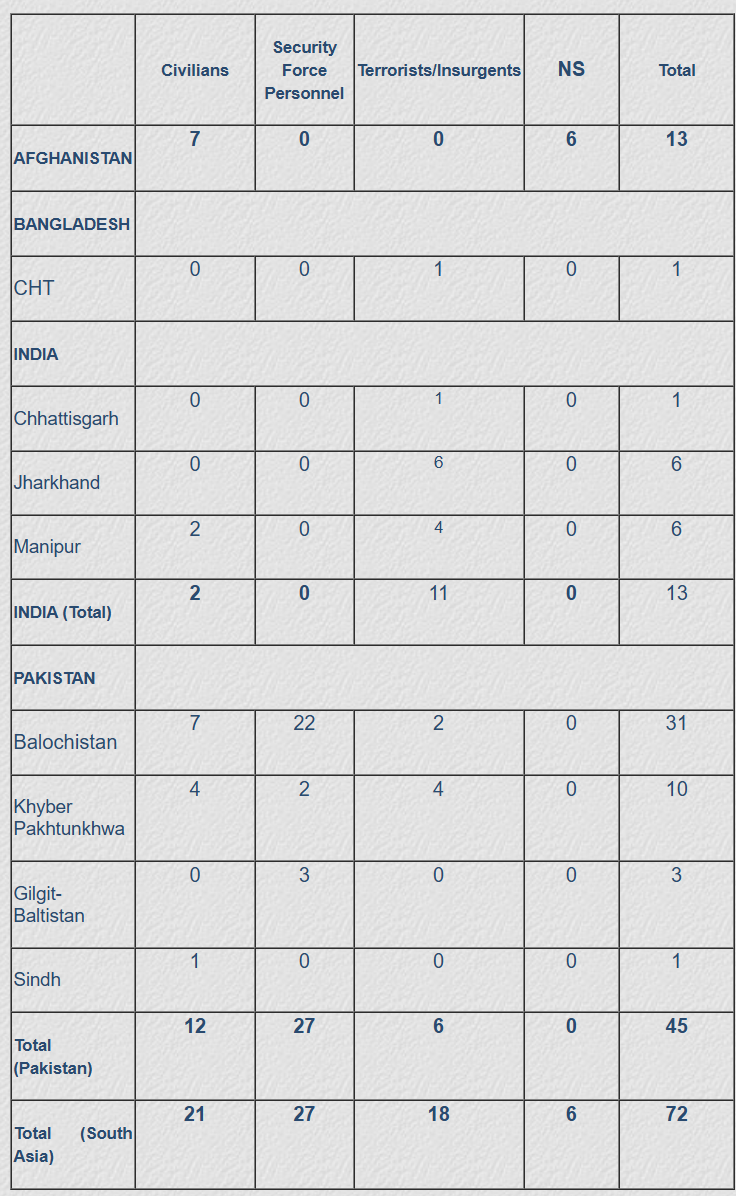
Provisional data compiled from English language media sources.