
South Asia Intelligence Review
Terrorist nexus in Rohingya camps
On May 14, 2026, a Rohingya man, Hasan Ahmed (45), a member of the Zakir Bahini, was shot dead by a Rohingya armed group, Saddam Bahini, at the Nayapara registered Rohingya refugee camp in the Teknaf Upazila (Sub-District) of Cox’s Bazar District. Police stated that members of the Rohingya armed group carried out the attack over dominance in the refugee camp, control of the mosque committee, and past enmity.
On May 12, 2026, a Rohingya youth, Hasmat Ullah (22), was shot at and injured in a clash between Rohingya armed groups at the B Block of Camp-8 at the Balukhali refugee camp in the Ukhiya Upazila of Cox’s Bazar District. According to the Police and Rohingya leaders, a dispute broke out between the Arakan Rohingya Army (ARA), a Rohingya armed group known as the Nabi Hossain Bahini, and another armed group, the Arakan Rohingya Organization (ARO), over dominance in the refugee camp, resulting in the incident.
On May 6, 2026, Mohammad Kamal Prakash Noor (45), the younger brother of Nabi Hossain, was killed in a shooting incident by unidentified assailants at the B-41 block of Camp-8 West in the Balukhali refugee camp in Ukhiya Upazila. It was also reported that Kamal was killed in suspected Arakan Rohingya Salvation Army (ARSA) firing due to the conflict between ARSA and ARA.
On May 5, 2026, ARO ‘commander’ Kefayet Ullah Halim (45) was killed in a gunfight with ARSA in the Tarjar Bridge area of the Balukhali refugee camp in Ukhiya Upazila. Two others who sustained gunshot injuries were identified as Mohammad Ullah (37) and Nur Mohammad (32). Under Halim’s leadership, ARO had been involved in anti-ARSA activities inside the refugee camp.
On May 4, 2026, a Rohingya youth, Mohammad Ullah (20), was arrested by the Police during an operation at the Leda Shelter Home in the Hnila Union of the Teknaf Upazila on charges of involvement with Tehreek-e-Taliban Pakistan (TTP). Police added that Mohammad Ullah was an active member of a WhatsApp group called Hakiqat News, affiliated with TTP. The group operates in Urdu and is accused of encouraging terrorist activities through international media platforms.
On April 28, 2026, the Detective Branch (DB) of the Dhaka Metropolitan Police (DMP) arrested four ARSA cadres – Imran Chowdhury (29), his brother Mostakim Chowdhury (25), Ripon Hossain Sheikh (28), and Abu Bakar (25) – from the Keraniganj and Kamrangirchar areas of Dhaka, for their links with TTP.
According to partial data collated by the Institute for Conflict Management (ICM), at least four persons killed and three injured (one Rohingya and two ARO cadres), linked to the Rohingya insurgency inside Bangladesh, have been reported this year (data till May 24, 2026). Further, 14 Rohingyas – including five linked with TTP, four with a trafficking ring, three drug traffickers, one ARSA ‘commander’, and one linked with ARA – have been arrested in Bangladesh this year, so far. In 2025, at least 37 people were killed, including three civilians and 34 militants. There were also 14 such arrests in 2025, including five cadres each from ARSA and ARA, and four from the Arakan Army.
In 2024, at least 42 people were killed in Rohingya-insurgency linked violence. The number stood at 95 in 2023, 22 in 2022 and nine in 2021.
The recent incidents in the Rohingya refugee camps, mainly in Cox’s Bazar, indicate an increasingly fragmented and militarised environment, where multiple armed Rohingya groups have been competing for territorial dominance, influence over camp governance structures, recruitment networks, and access to the illicit drug economy. The killings and shootings involving ARA/Nabi Hossain Bahini, ARSA, ARO, Saddam Bahini, and Zakir Bahini demonstrate that the camps are no longer witnessing isolated criminal rivalries, but rather sustained factional warfare among armed groups with evolving command structures.
The targeting of Majhis (local level leaders) and ‘commanders’ is particularly significant because these figures often serve as intermediaries between refugees, aid agencies, and Bangladeshi authorities. Their assassination reflects attempts by armed groups to capture informal governance mechanisms within the camps. While one Majhi each has been killed in year 2026 (so far), 2025, and 2024, year 2023 had recorded six Majhis killed.
The five Rohingya arrests made in Bangladesh this year in connection with TTP introduce a transnational extremist dimension that raises broader regional security concerns. While the cases currently appear limited to online radicalisation and digital propaganda dissemination, they highlight the vulnerability of displaced Rohingya youth to external extremist narratives amid prolonged statelessness, unemployment, insecurity, and frustration within the camps. Although there is no evidence yet of a formal TTP infrastructure operating inside Bangladesh’s Rohingya camps, the presence of ideological sympathisers or digital facilitators could potentially create future pathways for cross-border terrorist networking involving actors from Pakistan, Afghanistan, and Myanmar.
The Rohingya population remains concentrated in the bordering areas of Myanmar, particularly the Rakhine State, and crises or persecution targeting the community have repeatedly triggered refugee flows into neighbouring Bangladesh. On May 18, 2026, Human Rights Watch (HRW) released a report titled Skeletons and Skulls Scattered Everywhere: Arakan Army Massacre of Rohingya Muslims in Hoyasiri, Myanmar, from Bangkok, Thailand, describing the incident as a serious human rights violation, although the Arakan Army (AA) has never claimed responsibility for the massacre in the remote village of Myanmar. HRW reported that, on May 2, 2024, AA opened fire on unarmed villagers, with some of the survivors fleeing for safety into Bangladesh and Malaysia. HRW’s investigation found that the Myanmar military failed to take adequate measures to protect civilians. Meenakshi Ganguly, Deputy Asia Director, HRW, stated,
The Arakan Army’s killing of hundreds of Rohingya civilians and burning down their villages in Rakhine State in 2024 has taken the conflict with the country’s junta to a new level of brutality… The Arakan Army continues to hold the survivors captive. They have received no redress from the Arakan Army. Those responsible have not been held accountable.
Further, landmines planted by AA and abductions carried out by the group continue to threaten Rohingya living in the border areas between Bangladesh and Myanmar. According to Border Guard Bangladesh (BGB) data, at least 165 fishermen, who were detained by AA, between December 8, 2024 and May 12, 2026, when the AA seized Maungdaw (Myanmar) and took control of the Myanmar side of the border, still remain in the custody of the AA. During the same period, BGB brought back 234 fishermen. According to reports, landmines have been planted by AA in nearby border areas inside Myanmar to prevent the movement of armed Rohingya groups, which impacts the lives of people living near border areas in Bangladesh, especially the Rohingya who fled previously from that area. In a recent incident, on April 10, 2026, a Rohingya man, Mohammad Sadek (25), was injured in a landmine explosion that occurred on the Bangladesh-Myanmar border in the Balukhali area of the Ukhiya Upazila in Cox’s Bazar District. In another incident, on March 29, 2026, a Rohingya teenager, Abdul Hakim (15), was injured in a landmine explosion engineered by AA at the zero line of the Naf River on the Balukhali border in the Palangkhali Union of the Ukhiya Upazila in Cox’s Bazar District.
Additionally, Bangladeshi civilians and Rohingya residing in Cox’s Bazar have become victims of cross-border firing arising from clashes involving AA, Rohingya armed groups, and junta airstrikes in Rakhine State. For instance, on February 7, 2026, nine-year-old Huzaifa Sultana Afnan, who was fatally injured by a stray bullet fired from across the Myanmar border, succumbed to injuries in Dhaka. Afnan was critically injured in cross-border gunfire on January 11, 2026, amid ongoing clashes in Myanmar.
Meanwhile, on January 17, 2026, at least 18 members of the Mro ethnic minority were injured during an attack at Janali Para in the Nayapara Union of the Alikadam Upazila in Bandarban District. The attack was reportedly orchestrated by Rohingyas and settlers. Such incidents have the potential to further destabilize the already precarious security situation in the region.
When elections were conducted in Bangladesh this year after a tumultuous and chaotic 18 months, Rohingya militancy also emerged as an obstacle to the smooth conduct of the polls. In early January 2026, a Home Ministry report warned that the presence of armed groups and illegal weapons inside Rohingya camps, and the use of Camp-in-Charge outpasses or illegal crossing of barbed-wire fences into Ukhiya-Teknaf localities, could worsen the law-and-order situation. The report also cautioned that active social groups inside camps could spread rumours or provocative messages to destabilise the environment, while armed groups such as ARSA, the Rohingya Solidarity Organisation (RSO) and the AA could engage in clashes in border areas during the election period, creating fear among the public. The Election Commission and the Home Ministry were informed about a series of steps to mitigate risks involving Rohingyas during the election period. BGB was also directed to strengthen patrols ahead of elections, with heightened surveillance on armed groups along the Myanmar border. During the same period before elections, Bangladesh issued a high alert along its border with Myanmar on January 12, 2026, after detaining 53 ARSA militants who had crossed into its territory, according to Dhaka paramilitary officials, reflecting cross-border threats.
On February 5, 2026, joint forces, including Police, Border Guard Bangladesh (BGB), and the Army, detained 345 Rohingyas – including 176 men, 86 women, and 83 children and adolescents – during a late-night operation in Burma Colony under the Dohazari Municipality of Chandanaish Upazila in Chittagong District. Later, on February 8, 2026, at least 1,500 Rohingya refugees were detained in Ukhiya, Cox’s Bazar, during an Army-led joint security operation ahead of the February 12 parliamentary elections. The operation targeted Rohingyas living outside designated camps in the Balukhali and Palongkhali areas of Ukhiya Upazila.
The deepening Rohingya militancy represents a complex amalgamation of terrorism and a humanitarian crisis, posing a significant challenge for Bangladesh. Statelessness and the prolonged identity crisis among the Rohingya are increasingly pushing sections of the community toward militancy rather than integration for a stable future. According to the latest report of the United Nations High Commissioner for Refugees (UNHCR), approximately 149,769 Rohingya refugees were newly registered in Bangladesh between December 2024 and March 31, 2026, reflecting continued displacement linked to conflict and insecurity in Myanmar’s Rakhine State, as reported on May 14, 2026. UNHCR stated that the total registered Rohingya refugee population in camps across Bangladesh currently stands at approximately 1,194,123.
Recent incidents and broad trends collectively point toward several emerging risks, including violent competition among multiple Rohingya armed groups inside the camps, the gradual emergence of transnational security threats through potential extremist linkages and online radicalisation, and continuing obstacles to Rohingya repatriation due to persistent violence and mistrust in Myanmar involving both the Myanmar military and AA. Bangladesh continues to face the challenge of balancing internal security within densely populated refugee camps, while simultaneously managing its borders, growing illicit trade, and the complexities of addressing the Rohingya crisis through diplomatic channels.
Jharkhand: Unfinished Stabilization
Jharkhand remained one of the principal theatres of Left Wing Extremism (LWE) in India through the first half of 2026, despite the Government of India’s stated objective of substantially ending the Communist Party of India-Maoist (CPI-Maoist) insurgency by March 31, 2026. While Security Forces (SFs) achieved significant operational successes against the CPI-Maoist and its splinter formations, particularly in the Saranda Forest region of West Singhbhum District, the insurgency survived in residual form, adapting through asymmetric tactics, Improvised Explosive Device (IED) warfare, extortion networks, and mobile guerrilla formations.
The persistence of surviving armed cadres, extensive IED networks, splinter outfit activity, and unresolved governance and socio-economic vulnerabilities ensured that the State remained among the last significant residual Maoist theatres in India.
On May 19, 2026, an exchange of fire took place between SFs and CPI-Maoist cadres in the Porahat Forest area near Kedabir village under Sonua Police Station limits in West Singhbhum District. According to Superintendent of Police (SP) Amit Renu, the encounter occurred during a combing and search operation jointly conducted by the Commando Battalion for Resolute Action (CoBRA) 209 Battalion and Jharkhand Police, in the Sonua and Goilkera Forest areas. Maoist cadres reportedly opened fire after spotting the approaching SF personnel, prompting retaliatory fire by SFs. Police sources indicated that one or two Maoists may have sustained bullet injuries during the exchange, though no official confirmation was issued. No SF casualties were reported. SFs stated that arms and daily-use materials were recovered from the encounter site.
On May 10, 2026, former CPI-Maoist ‘commander’ Jagnarayan Yadav alias Vishal Yadav was found killed in the Belhara area under Pandu Police Station limits in Palamu District. Yadav had multiple facial injuries and investigators suspect he was bludgeoned to death by unidentified assailants. Yadav was a former Maoist ‘commander’ carrying a bounty of INR 500,000 announced by the Jharkhand Government. He was detained in 2015-16 in connection with several LWE-linked incidents. After his release from prison, he was reportedly living a normal life.
On May 9, 2026, Jharkhand Police arrested two cadres of the People’s Liberation Front of India (PLFI), a CPI-Maoist splinter outfit, during a raid in the Jilinga Forest area of Khunti District. A search operation was launched following intelligence inputs regarding the presence of PLFI members planning a major incident, organisational expansion, and ‘levy’ collection activities in the area. During the raid, SFs arrested the two PLFI cadres from the forest area. Police recovered two country-made pistols and two rounds of ammunition from their possession. Investigators stated that the arrested cadres were allegedly involved in efforts to strengthen the outfit’s network and extort money through ‘levy’ collection in the region.
On May 4, 2026, an alleged CPI-Maoist IED blast took place in the Saranda Forest area of West Singhbhum. Though there were no civilian or SF casualties reported, a 13-year-old elephant succumbed to injuries.
On May 4, 2026, Jharkhand Police arrested two cadres of the Jharkhand Jan Mukti Parishad (JJMP), a CPI-Maoist splinter outfit, during an operation in the Kurumkheta Forest under Chhipadohar Police Station limits in Latehar District. The arrested cadres were identified as Manoj Lohra, a resident of Jobla Panki in Palamu District, and Mahadev Singh, a resident of Simariyatand in Latehar District. Acting on intelligence inputs regarding the movement of armed JJMP cadres, SFs launched a joint operation, Operation Dragon, involving the Special Action Team (SAT) and District Police. The JJMP squad led by Shankar Ram was preparing to execute a major attack. During the operation, the JJMP cadres attempted to flee, but two of them were arrested after a chase, while Shankar Ram and others escaped. SFs recovered two Self-Loading Rifles (SLRs), one AK-47 rifle, magazines, 318 live cartridges, wireless communication sets, walkie-talkies, mobile phones, SIM cards, a Wi-Fi router, and other electronic devices.
On May 5, 2026, Viram Ram alias Vikram Ji alias Arvind Ji, a ‘sub-zonal commander’ of the Tritiya Sammelan Prastuti Committee (TSPC), a splinter group of the CPI-Maoist, was arrested with arms and ammunition during a raid in Latehar District. The 42-year-old cadre associated with TSPC for around 15 years, was arrested from his residence under Chandwa Police Station limits following specific intelligence inputs. At least 16 criminal cases are pending against him across multiple Districts. During the operation, Police recovered a pistol, seven cartridges, a mobile phone, and other incriminating materials.
According to partial data collated by the South Asia Terrorism Portal (SATP), at least 12 Maoist-linked incidents have been recorded in the state, after the passing of the March 31, 2026, deadline, (data till May 24, 2026).
Subsequent intelligence indicated that the CPI-Maoist leadership remained determined to continue armed struggle despite mounting setbacks. At least five incidents of arms recoveries have been recorded, post the March 2026 deadline, (data till May 22, 2026).
A May 22, 2026, report indicated that a 4,000-strong SF contingent, comprising the Central Reserve Police Force (CRPF), CoBRA and the Jharkhand Police, has intensified search operations inside Jharkhand’s heavily forested areas of the ‘Red Corridor’ in the Saranda Forest region, for Misir Besra alias Sagar alias Nirbhay, the last active politburo member, carrying a bounty of INR 10 million, and Asim Mondal alias Akash alias Timir, CPI-Maoist ‘Central Committee Member (CCM)’, who are said to be hiding there with their cadres. An unnamed Union Home Ministry (UHM) official thus disclosed,
A massive hunt has been launched to trace Misir Besra, the mastermind behind some of the deadliest attacks on security personnel in the region. Close to 4,000 personnel of the CRPF, CoBRA and the Jharkhand Police have been deployed to locate him. With the cordon tightening and supplies cut off inside the forest, surrender is the only option left for him. The operation in Saranda will mark the final chapter in the long pursuit of one of India’s most wanted Maoist commanders.
Significantly, on April 19, 2026, the CRPF had issued a one-month ultimatum to Misir Besra to surrender or face decisive action in Jharkhand’s Saranda Forest region. CRPF Special Director General (SDG) Deepak Kumar, during a visit to a security camp at Baliba village in West Singhbhum District, reviewed ongoing anti-Naxalite operations and outlined an intensified strategy. He stated that the operation was now in a targeted phase, focusing specifically on Besra. Kumar emphasised that surrender remained the preferred option, but warned of arrest or neutralisation within the stipulated timeframe. However, no surrender initiative has been reported so far, and operations continue with increased intensity to eliminate Maoist influence from the region.
SFs have reportedly cordoned off Maoist cadres within a 10-kilometre radius in the Saranda Forests, where approximately 45-50 extremists remain active. The Maoists have shifted to mobile camps and laid IEDs and spike holes to impede SF movement. The Maoists’ extensive use of explosives in ecologically sensitive forest corridors underscored the continuing dangers posed by residual insurgent infrastructure. Security officials assessed that ideological commitment within the outfit had sharply eroded, with extortion and criminal profiteering increasingly replacing revolutionary objectives.
The SF campaign intensified significantly after March 2026. These operations yielded further tactical successes. On April 17, 2026, two senior CPI-Maoist leaders, Anuj Da alias Sahdev Mahato alias Subhash and his wife Natasha alias Maheshwari Hodi, both linked to the Jharkhand Special Area Committee (JSAC), were killed during an encounter in West Singhbhum District. On April 15, 2026, at least four Maoists were killed during an encounter in Saranda Forest, in the Chaibasa area between Marang Ponga and Baliba villages under Chhota Nagra Police Station limits in West Singhbhum District.
Nevertheless, incidents suggest that remnants of splinter outfits such as the TSPC/Tritiya Prastuti Committee (TPC), PLFI, and JJMP remained active in several Districts, particularly Latehar, Chatra, Hazaribagh, Ranchi, Khunti, and Palamu.
Further evidence of continued splinter activity emerged on May 9, 2026, when two PLFI cadres were arrested in Khunti District while allegedly planning organisational expansion and levy collection activities.
Moreover, on April 30, 2026, two TSPC cadres were arrested near Irba Golchakkar in Ranchi District after extorting a businessman for INR 1 million.
The persistence of such splinter outfits demonstrates that, while the CPI-Maoist core had weakened substantially, localized armed criminal-extremist ecosystems remain operational in some parts of Jharkhand.
Despite major setbacks, the Maoist threat in Jharkhand remained operationally relevant due to two principal factors. First, the residual armed capability of surviving Maoist cadres remained substantially intact. Even weakened formations retained the ability to execute selective attacks, ambushes, and IED strikes. The extensive use of landmines and explosive traps continued to impede SF mobility and prolong operations in difficult forest terrain. Second, the insurgency retained cross-border strategic depth. Maoist movement corridors connecting Jharkhand with Chhattisgarh and Odisha remained active, particularly in forested tri-junction areas. Odisha Police acknowledged on May 1, 2026, that residual Maoist activity in Jharkhand continued to pose spillover risks into adjoining Districts.
The surviving insurgency in Jharkhand in 2026 reflects a transition from ideological violence toward hybridized criminal-extremist operations. Extortion from contractors, transport operators, mining-linked networks, and infrastructure projects remained central to the survival of several splinter groups. Nevertheless, the overall balance remained decisively in favour of the State. Sustained SF dominance, improved intelligence capabilities, road connectivity, technological surveillance, and surrender-and-rehabilitation policies have substantially reduced Maoist operational space.
In a positive development, on May 21, 2026, 27 CPI-Maoist cadres surrendered before SFs in Ranchi, under the State Government’s Operation Navjeevan rehabilitation initiative. The surrendered cadres laid down arms in the presence of Jharkhand Director General of Police (DGP) Tadasha Mishra and senior officials of Jharkhand Police, Jharkhand Jaguar and the CRPF. The surrendered Maoists were wanted in multiple Maoist-related cases across the State. Sources revealed that the surrendered cadres included top commanders and members associated with Besra’s teams. Among those who surrendered were six special zonal committee members, six area committee members, 13 CPI-Maoist squad members and two cadres of the JJMP, a Maoist group active in Gumla district. The Maoists surrendered with 17 weapons and nearly 3,000 rounds of ammunition. Officials appealed to the remaining cadres to abandon violence and return to the mainstream. DGP Mishra stated that joint anti-Maoist operations would continue across Jharkhand until extremism was fully eliminated, adding that the surrendered cadres would receive rehabilitation assistance from the Government. CRPF Inspector General (IG) Saket Singh also urged remaining Maoist cadres to surrender and rejoin society through the rehabilitation programme, declaring, “We appeal to those who have not surrendered to renounce the path of violence and come to the mainstream.”
The Maoist challenge in Jharkhand is no longer one of territorial insurgent dominance, but of residual extremist persistence. The CPI-Maoist and its affiliated splinter outfits retain limited disruptive capability, particularly through IED warfare and extortion, but lack the strategic strength necessary to regain large-scale – or even significant – territorial influence. The long-term stabilization of Jharkhand, however, will depend not solely on kinetic operations, but equally on governance consolidation, tribal-sensitive development, employment generation, protection of land and forest rights, and dismantling criminal-extortion ecosystems that continue to sustain residual extremist networks. Strategically, Jharkhand in 2026 represents a theatre of declining insurgency, but unfinished stabilization.
Weekly Fatalities: Major Conflicts in South Asia
May 18-24, 2026
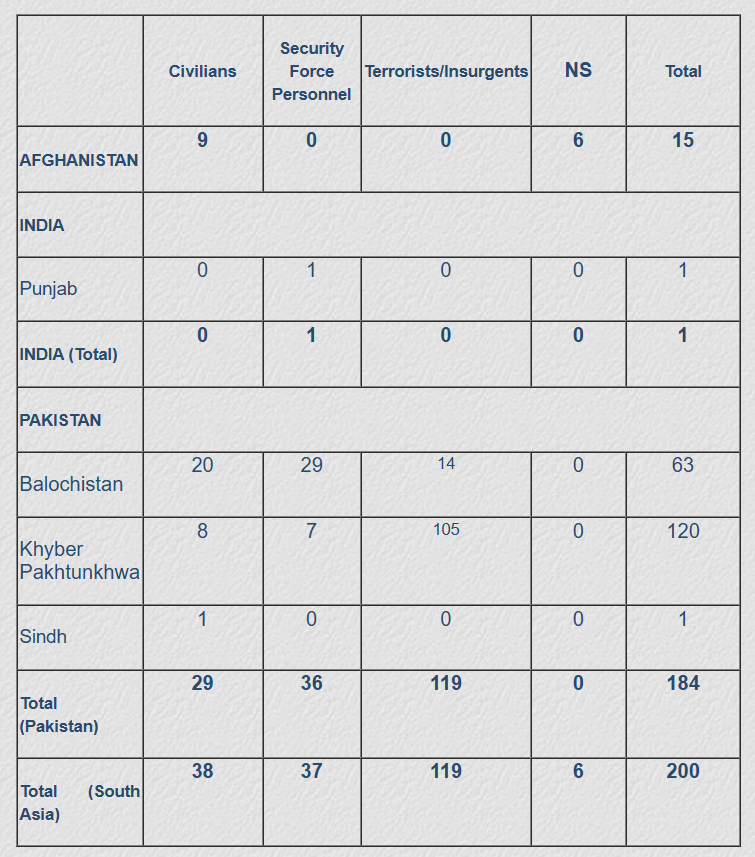
Provisional data compiled from English language media sources.