
Korean Peninsula Update, June 2, 2026
Toplines
North Korea is developing systems intended to improve its conventional artillery capabilities while dispersing its nuclear armament across hybrid platforms. Workers’ Party of Korea (WPK) General Secretary Kim Jong Un observed the first live-fire test of a modular missile launcher and a tactical cruise missile launcher on May 26.[1] The modular missile launcher resembles the US’s High Mobility Artillery Rocket System (HIMARS). It carries two launch pods capable of firing nine 240mm rockets or a single short-range ballistic missile.[2] North Korean state media released images of the test that show the modular missile launcher firing a Hwasong-11D short-range ballistic missile that can be equipped with a nuclear warhead.[3] North Korean state media also released images of a 22-tube launcher firing what it described as a “tactical cruise missile” with a 100-kilometer range.[4] Kim called for both systems to be deployed with long-range artillery brigades on the inter-Korean border and emphasized the development of capabilities that were “impossible to survive.”[5]
Both systems tested on May 26 underscore an emphasis on enhancing the precision-strike capabilities of North Korea’s artillery arm. Long-range precision fires have had a significant role on the Ukrainian battlefield, particularly when paired with reconnaissance drones.[6] North Korea may have observed this dynamic during its participation in the 2024 Kursk counteroffensive and is seeking to adjust its traditional emphasis on massed, inaccurate artillery fire as a result.[7] North Korea is likely deficient in the complex command, control, intelligence, reconnaissance, and surveillance architecture necessary to effectively develop a long-range precision fires system, however, and is likely to retain an artillery arm that is largely composed of Cold War-era systems as a result.
The modular missile launcher may also serve as a “hybrid” system that allows North Korea to arm its conventional warfighting platforms with nuclear warheads. Kim has directed North Korea’s nuclear forces to enhance survivability by dispersing nuclear launch capability across a wide variety of platforms.[8] Developing conventional weapons that retain the possibility of being nuclear armed could complicate South Korean and US efforts to neutralize North Korea’s ability to conduct a nuclear strike during a conflict.
North Korea resumed diplomatic exchanges with Singapore after seven years to improve relations with Association of Southeast Asian Nations (ASEAN) states as part of broader efforts to elevate the regime’s diplomatic standing. Singaporean Foreign Minister Vivian Balakrishnan held bilateral meetings with North Korean Foreign Minister Choe Son Hui and Chairman of the Standing Committee of the North Korean Supreme People’s Assembly (SPA) Jo Yong Won on May 26.[9] Balakrishnan visited North Korea as part of a five-day trip to the People’s Republic of China (PRC), North Korea, and South Korea.[10] The trip, arranged upon North Korea’s invitation, marked the first visit to North Korea by a Singaporean official since July 2019. Balakrishnan invited Choe to the ASEAN Regional Forum (ARF) scheduled for July in the Philippines, encouraged North Korea to engage “constructively” with the region, and urged North Korea to keep dialogue channels open.[11] Whether Choe accepted the invitation remains unclear. North Korea and Singapore have maintained limited but working diplomatic relations since establishing ties in 1975.[12] The relationship deteriorated from 2011 to 2018 due to North Korea’s nuclear weapon tests and the 2017 assassination of Kim Jong Un’s half-brother, Kim Jong Nam, in Malaysia. Bilateral relations resumed in 2019 when Singapore hosted a summit between US President Donald Trump and WPK General Secretary Kim Jong Un.[13] Bilateral high-level exchanges halted during North Korea’s border shutdown between 2020 and 2025 due to the COVID-19 pandemic.[14] North Korea and Singapore were unable to commemorate the 50th anniversary of the establishment of their diplomatic relations in 2025, which served as the impetus for North Korea’s invitation.
Balakrishnan met on May 28 with South Korean Foreign Minister Cho Hyun, Unification Minister Chung Dong-young, and Director of the National Security Council (NSC) Wi Sung-lac in Seoul.[15] South Korean officials explained the Lee Jae Myung administration’s “peaceful coexistence” policy and requested continued support from ASEAN member states, including Singapore, to help create conditions for dialogue with North Korea.[16] Chung stated on May 26 that the meeting with Balakrishnan would provide an opportunity to gauge North Korea’s intentions.[17] Balakrishnan told Singapore-based media outlet The Straits Times on May 28 that North Korea seemed more focused on strengthening military deterrence than external engagements.[18] Balakrishnan dismissed the speculation that Singapore would mediate a potential United States-North Korea dialogue.[19]
North Korea likely invited Balakrishnan to resume high-level exchanges with Singapore and strengthen relations with ASEAN countries. North Korea has increased bilateral exchanges with ASEAN member states, including Vietnam, Laos, and Indonesia, since reopening its border in 2025.[20] Singapore’s calls for North Korea’s participation in the ARF reflect continued efforts by ASEAN member states to maintain open diplomatic channels with North Korea.[21] The ARF remains the only multilateral framework to which Pyongyang is a member, attending the ARF almost annually since 2000.[22] North Korea may seek to advance two primary objectives through the ARF: challenging nonproliferation norms by countering denuclearization calls and furthering efforts to portray North Korea as a legitimate socialist state. ASEAN is unlikely to abandon its formal position on denuclearization, but increased high-level visits to Pyongyang by ASEAN member states likely strengthen North Korean objectives to advance the regime’s public perception. North Korea could seek trade opportunities with ASEAN member states beyond diplomatic support.[23] Balakrishnan’s visit also reinforced the limited prospects for engagement between South Korea and the United States.
Key Takeaways
North Korean Military Developments: North Korea conducted a live-fire test of a modular missile launcher that resembled a US HIMARS and a tactical cruise missile launcher on May 26 as part of its efforts to improve its conventional artillery capabilities. These systems may have the ability to be nuclear armed, which would complicate US and South Korean efforts to neutralize North Korean nuclear strike capabilities.
North Korean Diplomatic Relations: North Korea invited Singaporean Foreign Minister Vivian Balakrishnan to Pyongyang for the first time in seven years. North Korea is likely seeking to gain diplomatic support from Southeast Asian states, challenge nonproliferation norms, and improve perceptions of the regime. Singapore denied that it will facilitate dialogue between the United States and North Korea.
North Korean Domestic Politics
Nothing significant to report.
North Korean Military Developments
See toplines.
North Korean Foreign Relations
Russia reportedly insisted on removing all references to North Korea’s nuclear program in the final draft resolution during the 11th Review Conference for the Treaty on the Non-Proliferation of Nuclear Weapons (NPT). Russian support for North Korea weakens the effectiveness of international law and sanctions in constraining North Korea. The review conference was held at the United Nations (UN) from April 27 to May 22 and ended without a consensus resolution.[24] This is the third NPT conference in a row to end without a consensus, following the 2015 and 2022 conferences. The removal of all references to North Korea in the final draft is unprecedented, as NPT review documents have traditionally included language condemning North Korea’s nuclear program even if they were not adopted as a consensus outcome.[25] The South Korean delegation at the conference maintained that the document must call for North Korea’s denuclearization and refuse to recognize North Korea as a nuclear power.[26]
Russia’s advocacy on behalf of North Korea is the latest development in a trend of Russian-North Korean alignment since Russia’s full-scale invasion of Ukraine in February 2022. North Korea supplied between 40 and 70 percent of Russia’s monthly expended munitions in 2024, signed a mutual defense agreement with Russia in June 2024, and deployed troops to Russia’s Kursk region to help repel a Ukrainian incursion and assist with cross-border combat operations.[27] Russia has reciprocated by elevating diplomatic and economic relations with North Korea, providing technical assistance to aid in Pyongyang’s military modernization, and pushing for an end to North Korea’s international isolation.[28] Russia vetoed new UN sanctions on North Korea in 2022, vetoed extending the mandate of the UN Panel of Experts monitoring sanctions compliance in 2024, and declared North Korea’s nuclear program a “closed issue” in 2024.[29] Russian support for North Korea may embolden North Korean aggression and military development by reducing the effectiveness of sanctions and deterrence against North Korea.
The PRC’s omission of calls for North Korean denuclearization following the 2026 Quad Foreign Ministers’ meeting in New Delhi on May 26 likely strengthens North Korean demands for the regime to be acknowledged as a legitimate nuclear state. The foreign ministers of the United States, Japan, Australia, and India issued a joint statement on May 26 calling for the “complete denuclearization” of North Korea during the 2026 Quad Foreign Ministers’ meeting in New Delhi.[30] They urged North Korea to comply with all relevant UN Security Council (UNSC) resolutions, condemned North Korea’s ballistic missile and weapons of mass destruction development programs, and expressed concern about North Korea’s cyber activities and IT worker operations.[31] The ministers also expressed concern about countries deepening military cooperation with North Korea in ways that undermine the global nonproliferation regime, likely referring to Russia.[32] North Korean state media on May 28 published a commentary criticizing the Quad’s May 26 joint statement, reaffirming that North Korea’s denuclearization will “absolutely never happen, now or forever,” and that the issue is North Korea’s “legitimate exercise of sovereign rights.”[33] PRC Foreign Ministry Spokesperson Mao Ning stated on May 28 that the PRC’s position on the Korean Peninsula remains consistent, while adding that it opposes “the creation of small groups and bloc confrontation,” referring to the Quad.[34]
The PRC has halted calling for denuclearization of the Korean Peninsula since resuming diplomatic engagements with North Korea following the September 3 summit between WPK General Secretary Kim Jong Un and Chinese Communist Party (CCP) General Secretary Xi Jinping.[35] The PRC last mentioned denuclearization during a trilateral meeting with South Korea and Japan in May 2024.[36] The PRC’s omission of denuclearization rhetoric reflects a shift in its explicit support of denuclearization of the Korean Peninsula. ISW-CDOT previously assessed that the PRC is weakening denuclearization pressure to improve its relationship with North Korea and counter increasing Russia-North Korea alignment.[37] North Korea likely views the shift in the PRC’s stance as a tacit acceptance of its status as a nuclear state, a demand the regime has consistently advanced in diplomatic settings. The United States-led efforts to pressure North Korea’s abandonment of its nuclear program have weakened in recent years following the 2024 Russian veto and PRC abstention against renewing the UNSC Panel of Experts—a North Korean sanctions evasion monitoring team.[38]
Russia is considering cooperative efforts with the North Korean intelligence services as part of their broader bilateral cooperation. These efforts could facilitate Russian-North Korean intelligence sharing and/or precede North Korean intelligence operations targeting Ukraine. Russian Security Council Secretary Sergei Shoigu announced that Russia was considering cooperation between the Russian Security Council and the North Korean State Intelligence Service during a bilateral meeting with North Korean Minister of State Security Lee Chang-dae on May 29.[39] Shoigu stated that such cooperation efforts were an “important” part of fulfilling the 2024 Comprehensive Strategic Partnership Treaty signed by Russian President Vladimir Putin and WPK General Secretary Kim Jong Un. Russian state media articles discussing Shoigu’s statement did not include details on what this cooperation might entail, but they described Russia as deeply grateful for North Korea’s involvement in Russia’s military operations in Kursk Oblast.[40]
Russia and North Korea have significantly increased their security cooperation since Russia’s 2022 invasion of Ukraine.[41] This increased security cooperation will further benefit the bilateral relationship and have the potential to facilitate intelligence sharing or North Korean intelligence operations against Ukrainian military forces. North Korea has benefited significantly from cooperation with Russia, including Russia’s push to reduce sanctions on North Korea and normalize North Korea’s nuclear program. [42]
North Korean Cognitive Warfare
Nothing significant to report.
Inter-Korean Relations
Nothing significant to report.
South Korean Domestic Politics
South Korea’s local elections outcomes in key swing provinces will indicate public approval of the Lee Jae Myung administration and ensure its policy momentum. Early voting for South Korea’s 9th local elections started on May 29 and 30.[43] The main voting day is June 3, with the vote counting scheduled to begin at 6 p.m. local time. Candidates are competing for 16 provincial and metropolitan governor positions; 225 district, city, and county chief positions; 804 provincial and metropolitan council seats; 129 provincial and metropolitan proportional-representation seats; 2,650 municipal, city, and county council seats; 385 municipal and county-proportional-representation seats; and 16 provincial superintendent of education positions.[44] The main contenders are South Korea’s two major political parties—the progressive ruling Democratic Party (DP) and the conservative opposition People Power Party (PPP)—alongside minor parties including the Rebuilding Korea Party, Reform Party, Progressive Party, Basic Income Party, Social Democratic Party, Justice Party, Labor Party, Green Party, and Liberty Unification Party.
The elections come one year after South Korean President Lee Jae Myung took office in June 2025 and precede the 2028 legislative elections and 2030 presidential election. The results of this election thus reflect public sentiment toward the Lee administration and determine local governance dynamics, including whether officials who seek to support or constrain Lee’s policy agenda will lead the local governments. Key battlegrounds include Seoul, Busan, Ulsan, and Daegu. South Korea watchers will observe the extent to which the DP expands its gains in these regions or whether the conservative bloc will retain its base. Key by-elections for National Assembly seats in Busan and Gyeonggi Province are also likely to determine the political standing of major party figures who may run for president in the future.[45]
The ruling DP is seeking victories in 15 provincial and metropolitan governor elections.[46] DP leadership has assessed improved competitiveness in key battleground areas based on polling results, and potential DP victories in traditional conservative strongholds—such as Daegu—which would mark a symbolic shift of conservative voter alignment. Current polling shows Busan leaning DP, while Seoul, Ulsan, and Daegu remain contested.[47] The PPP previously won most provincial and metropolitan governor races, including in Seoul, Incheon, Gangwon, South Chungcheong, Sejong, Daejeon, North Gyeongsang Province, Daegu, Ulsan, Busan, and South Gyeongsang Province in the 2022 local elections.[48]
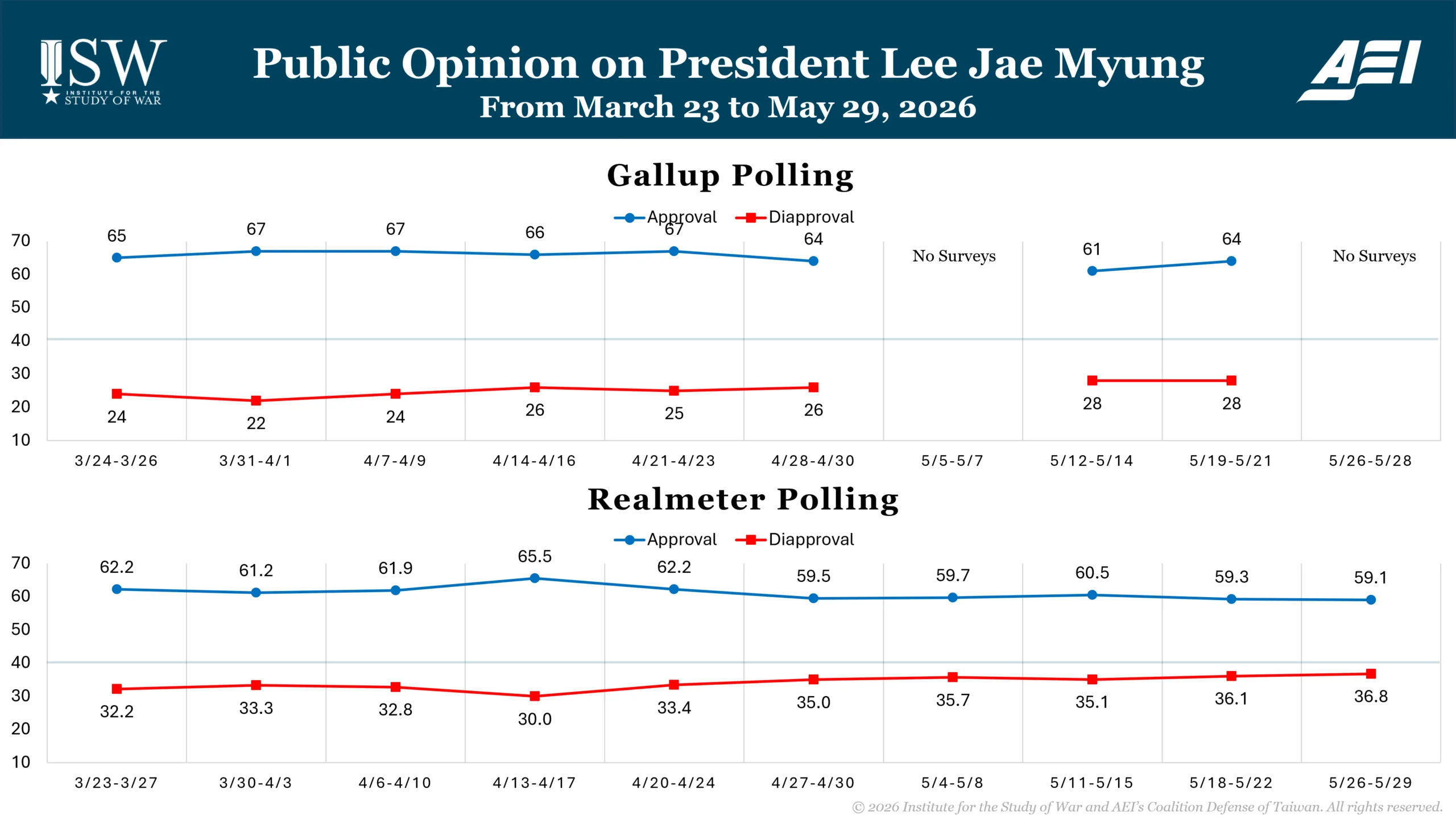
South Korean President Lee Jae Myung maintained high approval ratings within the 59-60 percent range throughout May. Lee’s approval ratings dropped by one to two percentage points compared to April, with economic policy driving the overall consistency of Lee’s rating. Realmeter reported that Lee recorded an approval rating of 59.1 percent in the fourth week of May, marking Lee’s lowest approval rating for the month of May.[49] Lee hit his monthly peak in the second week of May at 60.5 percent approval.[50] Lee’s ratings generally declined from March and April when his numbers climbed to set historic highs, however. The administration’s proactive preventive measures against the impact of Middle East conflicts and resulting energy shortages led to the increase.[51] Lee recorded 65.5 percent approval in the third week of April, marking his highest approval rating since his inauguration.[52] Realmeter attributed the consistency of Lee’s ratings to the rapid growth of the Korea Composite Stock Price Index (KOSPI), despite expanding conservative consolidation ahead of the local elections scheduled for June 3.[53] The KOSPI crossed 8,800 points for the first time on June 1, surging by approximately 1,200 points during May alone.[54] The stock index has expanded more than threefold within a year. The KOSPI stood at 2,770.84 points at the time of Lee’s inauguration on June 4, 2025.[55] A Gallup poll similarly indicated that Lee maintained his baseline approval ratings, in the low 60 percent range, even with a slight decrease from April.[56] No major national security and diplomatic variables have exerted leverage on public perceptions of the administration throughout May.
Counter-North Korean Coalition Building Efforts
South Korea will likely seek to secure the transit of South Korean vessels through consultations with Iran rather than military participation in the United States-led operations in the Strait of Hormuz. The South Korean government concluded on May 27 that the two unidentified projectiles that struck the South Korean vessel HMM Namu-ho in the Strait of Hormuz on May 4 were Noor-series anti-ship missiles developed and manufactured in Iran.[57] South Korean Vice Foreign Minister Park Yoon-joo stated that “various pieces of evidence point toward Iran.”[58] Iranian Ambassador to South Korea Seyed Kouzechi denied Iranian involvement in the attack following a meeting with Park on May 27, however.[59] Seoul-based outlet Chosun Ilbo reported on May 29 that the warhead recovered from the strike was a GHAD-55, a munition designed to penetrate a vessel’s hull and detonate inside the ship.[60]
US President Donald Trump urged South Korea on May 5 to join the United States-led “Project Freedom” operation to reopen the Strait of Hormuz, claiming that Iran had fired on the South Korean vessel.[61] South Korea withheld an immediate response while investigating the attack.[62] Director of South Korea’s NSC Wi Sung-lac said on May 13 that South Korea was reviewing participation in the United States-led “Maritime Freedom Construct (MFC)” operation to secure safe passage for ships transiting the Strait of Hormuz. The South Korean Ministry of Foreign Affairs (MOFA) said on May 14 that South Korea would undertake a “diplomatic offensive” against the attacker.[63] MOFA stated on May 28 that it was difficult to answer whether South Korea would participate in the US operation, however.[64]
South Korean military support for US operations remains unlikely in the near term, as the South Korean government has not taken additional actions against Iran or responded to US calls for participation, at time of writing. MOFA has also refrained from characterizing the attack as intentional, noting that multiple actors—including the Iranian Navy, the Islamic Revolutionary Guard Corps, and Iran-aligned proxy groups—use this type of missile.[65] Around 25 South Korean vessels remain in the Strait of Hormuz, at time of writing. One South Korean vessel transited the strait following an agreement with Iran on May 20. The South Korean government denied that the agreement was connected to the attack. Three Japanese vessels transited the Strait of Hormuz after the Japanese-operated container ship ONE Majesty was struck by a projectile in the Persian Gulf on March 11.[66] South Korea may similarly seek to secure the passage of its remaining vessels through negotiations with Iran.